BooksForKidsBlog

Saturday, December 25, 2021

Special Delivery! The Lost Package by Richard Ho
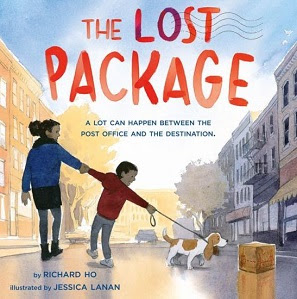
LIKE OTHER PACKAGES, THIS ONE BEGAN WITH AN EMPTY BOX.

A child places a carefully chosen gift inside, secures the flaps with great care and lots of tape, and addresses it with a personal message, and with a dog on leash, a boy and his mom set off down the sidewalk to the big post office, where the box is weighed and stamped and begins its travels

It moves through the wondrous process of the conveyor belt where magical devices measures sort, and route it to to the airport. But on the way, the delivery truck hits a pothole, the door flies open, and, unnoticed by the truck's driver, the box bounces out and into the puddle alongside the curb, where a curious dog is walking with a boy and his mother.

The dog pulls on his leash to give the package an investigative sniff, while the boy and his mother read the address on the label.

THE BOX WAS TATTERED BUT ITS DESTINATION WAS CLEAR.

The boy and his mom exchange surprised looks as they realize that they and the box are making the trip to the same place. The package takes its place in their moving truck with boxes of their belongings. All day they drive down the long, wet, rainy roads taking them to their new home.

And when they arrive, their first stop is at the very address on the lost-and-found box, where another surprised boy and his amazed mother open the door to find them on their doorstep.

NOT ALL PACKAGES TRAVEL THE SAME ROAD.

SOME GET LOST. SOME GET FOUND.

But this one is delivered, not by Santa, but by a really kind boy and mom, in this sweet story of a gift, lost, found, and delivered by hand by perhaps new friends, in Richard Ho's The Lost Package (Roaring Brook Press, 2021), lovingly illustrated by Jessica Lanan's rain-burnished artwork.

Says Publishers Weekly in a their starred review, "The richness of the tale lies in subtly textured watercolor illustrations by Lanan (The Fisherman and the Whale), which poignantly portray a broad range of settings, from gritty urban streets shimmering with rain to snow-swept terrains to a desolate gas station."

Labels: , ,

Tuesday, October 26, 2021

Australia's Native Dog! Dingo (Australian Animals) by Grace Hansen


Every kid knows a pet dog when he or she sees one, whether it's a Chihuahua or a Great Dane or a mixed-breed mutt!

But dogs have not always been tame pets, and despite the millions of domesticated dogs all over the globe, they haven't always been friendly helpers and pets for humans. There are other wild dogs all over the world, too, who can reveal a lot about the story of dogs.

In North America there are "wild dogs" also--foxes, coyotes, and wolves--who look a lot like dogs, but are wild, not pets. And on the big continent of Austraila, there are wild dogs, too. They are called dingoes.

DINGOES CAN SURVIVE IN DIFFERENT HABITATS--FROM TROPIC TO DESERT TO ALPINE AREAS.

Dingoes are medium-sized and usually tan or reddish brown, with fluffy tails and upright pointy ears, like foxes. Like many canines, they have white markings on feet, legs, and bellies. Like coyotes and wolves, they can live alone or with a pack who move around together. Like their wild American cousins, they hunt small or medium-sized animals and will also eat plants and fruits when they can get them.

THESE WILD DOGS ARE SMALL AND LEAN--NO MORE THAN FOUR FEET LONG AND 33 POUNDS.

Like their North American wild cousins, dingoes are born in litters of up to ten pups and stay with their mother and her pack until they grow up and learn to find food on their own. Again, like their cousins, the fox, coyote, and wolf, they are versatile hunters capable of surviving in most climates. And if the pack gets too big and there is too much competition for food, some of them may go off and begin their own new pack.

Dingoes are fascinating creatures, easy to mistake for the average dog, but definitely wild and wily, capable of living in a wide range of habitats, in Grace Hansen's Dingo (Australian Animals (Ak)) (Abdo Kids Books,2020). One of the publisher's series on Australian Animals, this non-fiction book for primary graders offers up-close and personal color photographs of this wild dog of Australia, easy-to-read but information-packed pages, backed up by appended sections--More Facts, Glossary, and Index in a well-conceived introduction to non-fiction books for the lower grades, perfect for those first science reports.

For fiction fans, pair this one with Mary Pope Osborne's time-traveling but fact-filled Australian outback adventure, Dingoes at Dinnertime: Magic Tree House, Book 20

Labels: , , ,