BooksForKidsBlog

Friday, January 28, 2022

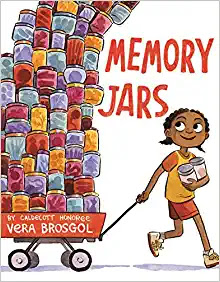
If Only! Memory Jars by Vera Brosgol

<

ON A HOT, SWEET JULY DAY, FREDA WENT BLACKBERRY PICKING WITH GRAN.

THE BERRIES TASTED LIKE SUNSHINE.

THEY WOULD NEVER BE BETTER!

Still, Freda couldn't eat all those blueberries at once.

But Gran says she can save them for another time. They can put them in jars to preserve ALL the sweet goodness. Freda remembers Granpa eating blueberry jam on his toast when she was little..., and . . .

FREDA HAD AN IDEA!

She tries putting one of Gran's fresh chocolate cookies, hot out of the oven, in a jar, and when she opens the jar the next morning, the aroma of the cookie was sweet and fresh. Soon Freda sets out to save every good thing she loves--from beautiful music, a rainbow, and some stars she gathered from the night sky. When her best friend Jack was sad that he was moving to Arizona, she saves him in a jar. Finally, all of Freda's favorite things are saved in one jar or another! And Gran is almost out of empty jars. But one day, when they have eaten the last of the blueberry jam, Freda realizes that she has a problem!

Should Freda put the last hot toast with blueberry jam away in the jar? But then, she would never taste that warm crunchy toast with warm, sweet blueberry savor....

Maybe she should just live in the moment, in Caldecott honor-winning author-illustrator Vera Brosgol's latest, Memory Jars (Roaring Brook, 2021). There are problems, any way you go. Now, or later, which is best? And how many jars are there for all the things we love? Not enough! Vera Brosgol's endearing little preservationist is so charmingly cute that kids will delight in her little dilemma, which inspires us all to enjoy the moment, but also to see that sometimes it's best to just savor the memory.

Vera Brosgol's winning Caldecott Honor book is This One Summer.

Labels: , , ,

Saturday, December 11, 2021

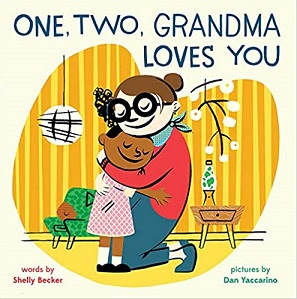
What Can Two Do? One, Two, Grandma Loves You! by Shelley Becker

ONE, TWO, GRANDMA LOVES YOU!

Grandma and her little granddaughter love to be together. They love to do the same things--draw pictures of each other, shop in toy stores, go fishing, and make pancakes, paint pictures, and paint their nails the same colors!

But the visit must end sometime, and when the girl goes back home, Grandma is so alone.

What can they do?

They yak on the phone for hours. They mark their calendars and cross off the days until they can get together again! They mail each other paintings and drawings of things they like to do together, and post the pictures everywhere. And they can't wait to see each other again!

"NINE, TEN, PLAN AGAIN!"

They count the days and think of ways to have fun the next time they are together, and Grandmother and Granddaughter count the ways they can be together, in Shelly Becker's latest, One, Two, Grandma Loves You (Abrams Appleseed, 2021). Author Becker delivers the rhymes and artist Dan Yaccarino provides the comic drawings of the good times, in this easy-to-read, easy-to-love book.

Says School Library Journal's starred review,, "Why does it ever have to end? The details in the illustrations will have children poring over the pages, where the clues to good times past and present add up to a generous look at the special bonds of an extended family."

Labels: , , , ,

Monday, October 11, 2021

Neighbors: Bird House by Blanca Gomez


ON A SNOWY DAY, MY ABUELA AND I FOUND AN INJURED BIRD.

ABUELA TOOK CARE OF IT.

The bird has a broken leg and back at home she bandaged it and put the little bird in an upright bird cage in their living room. The bird seems happy, and the cat is curious. As the little yellow bird's leg heals, Abuela lets it fly around their apartment to keep its wings strong.

IT WAS FANTASTIC!

The cat is fascinated. And Abuela begins to build a little bird house.

And when the bird's leg is healed, Abuela says it is time to let it fly free again. The cat is a bit upset, and the girl is sad, as the little yellow bird flutters up and soars away, soon lost among the tall buildings and the clouds. But Abuela and her granddaughter put up their bird house right away, right beside the door.

SNOW MELTED INTO SPRING.

And one day, when Abuela is watering her flowers on the balcony, the yellow bird returns to check out the new bird house and become their new neighbor....

In author-illustrator Blanca Gomez' newly published Bird House (Abrams Books, 2021), there are many gentle lessons, the nurture of a grandparent for a small child, and the care and the respect for all creatures that share our world. Gomez' meticulous paper collage illustrations are both simple and softly evocative of the theme of this lovely story.

Says Kirkus, "The simple, flowing first-person narrative flits from page to page in a gentle lilting commentary on harmony and respect."

Labels: , , ,

Friday, June 04, 2021

Making a Difference: Those Shoes by Maribeth Boelts

Jeremy longs for those shoes--the cool black hightops with two wide white stripes--the kinds that the B-ball stars wear. They show up first in his class at school on just one boy--Brandon--and then on a lot of the other boys, who strut down the halls to the bathroom just to show them off. Brandon even brags that his shoes make him the fastest runner in the class.

Jeremy tells Grandmother that he wants those shoes.

"THERE'S NO ROOM FOR "WANT" AROUND HERE. JUST NEED," SHE SAYS. "WHAT YOU NEED IS NEW BOOTS FOR WINTER!"

Then one day at school one of Jeremy's old shoes fall apart in a kickball game, and the guidance counselor takes him down to the box of spare clothes, but the only shoes that fit him are like baby shoes, with Velcro instead of shoestrings and a cartoon animal on the sides. And when Jeremy comes back to class, all the boys in the class laugh, everyone except Antonio Parker.

"I'M NOT GOING TO CRY ABOUT ANY DUMB SHOES," JEREMY TELLS HIMSELF.

But Grandmother notices and and takes him downtown to search for the shoes he wants at the thrift stores. At the third store, Jeremy spots the perfect pair, brand new, and tries them on. There's barely room for his toes, but Jeremy laces them up happily. Grandmother is not fooled, so Jeremy buys the shoes with his own money--$2.50! A few days later, Grandmother puts a new pair of snow boots in his closet and says nothing about Jeremy's feet, already sporting several bandaids.

But Jeremy's sore feet force him back into the sneakers with the dumb cartoon. He notices that Antonio's shoes are mostly held together by tape. His feet are smaller than Jeremy's, and suddenly Jeremy knows what he has to do.

I RUN ACROSS THE STREET AND PUT THE SHOES IN FRONT OF ANTONIO'S DOOR, PUSH THE DOORBELL--AND RUN!"

One good turn deserves another in Maribeth Boelts' Those Shoes (Candlewick Press), and when the next day brings snow, Jeremy proudly pulls on his brand new boots, never worn by anyone! Author Boelts handles this story of shoe envy and product bullying with diplomacy and a touch of humorous irony as well, and artist Josh Z. Jones' artwork perfectly portrays the all-too-real feelings about footwear that elementary kids have. Says Kirkus Reviews, "Boelts blends themes of teasing, embarrassment and disappointment with kindness and generosity in a realistic interracial school scenario."

Labels: , , ,

Sunday, February 07, 2021

When The World Grows Quiet....: Ten Ways to Hear Snow by Cathy Camper

WHEN LINA WOKE UP, EVERYTHING WAS QUIET.

It was a different quiet--no sounds of cars, buses, and garbage trucks. The snow had fallen and left the world muffled and so quiet.

But Lina was supposed to help her Grandmother cook her specialty that morning!

SHE BUNDLED UP.

The sunshine reflecting off the snow was twice as bright as usual. But the silence was so deep that it seemed strange.

Then she heard a new sound:

SCRAAAPE! SCRAAAPE!

Mrs. Watson's snow shovel was one way to hear snow!

SNYAK SNYEK SNYUK!

Lina's boots leave behind a series of sounds and waffle prints on the sidewalk.

As Lina walks down the snowy street, she hears other snow sounds. Blobs of snow plop to the ground off snowy branches, skiis go swishy swish through the park. She spots a friend building a snowman with a pat-pat-pat and as she walks on...

THWOMP! HER FRIENDS TOSS A FRIENDLY SNOWBALL HER WAY.

When she arrives at her grandmother's building, she adds to the snow sounds with a STOMP, STOMP, STOMP! of her snow boots.

Inside, Lina finds her Grandmother Sitti waiting and the lamb and rice are done simmering for the filling for the grape leaves. Lina and her grandmother have fun rolling them up into little bundles. Lina held one right under her nose like a bushy mustache.

"WE LOOK LIKE A COUPLA REAL TOUGH GUYS!" LAUGHS GRANDMOTHER SITTI."

Lina hears a dripping sound coming from her thawing mittens.

"THAT'S ANOTHER WAY TO HEAR SNOW," SHE THINKS.

>

And that evening Lina opens her window and hears the deep quiet outside, the tenth way to hear snow, in Cathy Camper's lovely snow day story, Ten Ways to Hear Snow (Kikali/Random House, 2020), illustrated in loving and lovely drawings by Kenard Pak, done in soft, "hushed" colors to fit the theme. Camper's sweet story introduces onomatoepoeia to young readers in the distinctive sounds and lack of them in the snowy scene which will tune youngsters' ears to the sounds of silence that snowfall brings. Share this one with Ezra Jack Keats' Caldecott-winning classic,

Labels: , ,

Monday, December 21, 2020

Fences: Between Us and Abuela: A Family Story from the Border by Mitali Perkins

Abuela stars in all of Mama's stories, but my only memory is a voice calling me "Angelita." We haven't seen my grandmother in five years. But today is La Posada Sin Frontiers, and we are taking a bus to the border to meet her.

Maria, her mom, and her little brother Juan board the bus to the Border Field State Park in San Diego. Mama is knitting the last few rows on a scarf for Abuela which Maria has been working on for weeks and little Juan clutches his gift for his grandmother, a drawing of Mary and Joseph at an inn with a sign that says "NO RUME." At the park they wait for the border officers as they allow small groups to enter the space between the two border fences between Mexico and the U.S. to meet their families on the other side.

At last it's their turn. She hears a voice calling her mother's name.

"Sylvia! Sylvia!

And then Maria hears a now familiar voice, her grandmother's!

"Juan! Maria Angelita!"

"I'm still her little angel," Maria thinks happily.

The openings in the fence are small, only big enough to touch each other with fingers, but their words travel back and forth quickly. But Maria's knitted scarf is not allowed through by a border officer who gives it back to her. Mama' promises to mail it to Abuela, but Maria is still sad. But what about her little brother's drawing? Maria thinks about that as priest leads a short Posado service and the officers tell them it's time to go. But Maria has an idea to get her brother's gift to Abuela.

"Abuela, esparate'! Wait!" she calls.

Sitting on the sand, Maria takes the knitting needles and yarn from her mother's bag and fashions a kite out of Juan's drawing, and on the third try, the little kite soars over the two fences as the crowd and border officials alike applaud. Mama' cuts the yarn and the kite wobbles and drops into the sand of Mexico, where Abuela picks it up and carries it carefully home.

In a touching story of family life at the border, Mitali Perkins' Between Us and Abuela: A Family Story from the Border (Farrar, Straus and Giroux, 2019) show that love indeed knows no borders. In the skillful illustrations of Sara Palacios, the kite and yarn become apt symbols of the ties that bind families together despite closed borders and steel fences. A Christmas-themed story for young people that speaks volumes. "A story of family strength and unity overcoming fences along the Mexican/United States border. Another poignant piece to add to the current national discussion about the border. A must for any collection," says School Library Journal's starred review.

Labels: , , , ,

Thursday, November 12, 2020

Making a Splash! Cannonball by Sacha Cotter

I'm always dreaming of pulling off that perfect cannonball. A booming one! A slapping one. A splashing, dripping, soaring one! Do an amazing cannonball around here and you will be something, all right. SomeONE!
The competition is considerable! The Kneelock! The Coffin Drop! The Manu! They're all a hard act to follow. His Nana tries to build up his confidence, but then one attempt from the sky-high platform leaves him clinging to the board, providing a good laugh for all the big guys below.
Sometimes I think I'm just not cut out for cannonballs!
Everybody thinks they know the secret. Weigh more. Get taller. Get bigger swim trunks! OR JUST...
"JUMP ALREADY!"
But Nana has the best advice.
"Do it your way!"
So with the breeze in his hair, he dances through the air, and.... ... with a colossal, spectacular, super SPLASH, he lands a memorable cannonball that soaks everyone thoroughly. YAY! It's mission accomplished in Sacha Cotter's how-to story, Cannonball (Sourcebooks/Jabberwocky, 2020). Sacha Cotter's story of making the scene with a big splash is set in New Zealand, giving a bit of South Pacific color and feel to a story of achieving the milestone of that big jump that is a universal childhood experience. Populated with plenty of voluble advisors and nay-saying critics, Cotter's upbeat narration is punctuated with jolly rhymes and enlightened by a supportive grandmother to add to this joyful rite of passage. Pair this one with Gaia Cornwall's delightful Jabari Jumps (read review here), another story of making that leap of faith into the rest of your life.

Labels: , ,

Monday, August 03, 2020

Be the Best You! Stand Tall, Molly Lou Melon by Patty Lovell

Molly Lou Melon was the shortest girl in her class.

Her grandma had told her, "Walk as proudly as you can and people will look up to you."

Molly's front teeth stick out so far she can stack pennies on them, but her grandma tells her to smile broadly and everyone else will smile with her.

Her voice is croaky as a bull frog's, but Grandma tells her to sing loud and clear and the world will be full of joy.

And what Grandma said was true... until Molly Lou Mellon had to say good by to her Grandma, move to a new town, and start at a new school.

Her new school had a bully--Ronald Durkin--who seemed to think it was his job to point out Molly Lou Mellon's shortcomings.
On the first day of school, Ronald Durkin called her SHRIMPO.

So Molly Lou Mellon caught a pass and ran right under Ronald Durkin's legs.  TOUCHDOWN! The kids cheered for Molly. So the next day Ronald Durkin was waiting with a new insult.
He called her "BUCKY THE BEAVER."

And Molly stacked pennies on her teeth and made all the class giggle in amazement. Ronald Durkin was appropriately abashed. But in music class the next day he sneered.
"You sound like a FROG!"

But Molly Lou Melon quacked so loud that Ronald Durkin fell over backward and had to go to the nurse's office for the rest of the afternoon. The rest of the class didn't miss him much either.

And Molly Lou Melon writes Grandma a letter.
"Dear Grandma,

Everything you told me was exactly right!"

"Be the best you that you can be," is good advice in Patty Lovell's beat-the-bully-at-his-own-game story, Stand Tall, Molly Lou Melon (G.P. Putnam's Sons), comically illustrated by noted artist David Catrow in his typically quirky style, who shows that keeping your cool and your smile can go a long way. Says Publishers Weekly, "Catrow's full-bleed pencil-and-watercolor illustrations, awash in ripe colors and animated by slapstick exaggeration, radiate a winningly eccentric elegance."

For more giggle-bait, share this one with Lovell and Catrow's Have Fun, Molly Lou Melon and David Catrow's hilarious I Ain't Gonna Paint No More! (Ala Notable Children's Books. Younger Readers (Awards)) and Take Me Out of the Bathtub and Other Silly Dilly Songs.

Labels: , , ,

Sunday, January 19, 2020

An Unlikely Mountain Lion: Puma Dreams by Tony Johnston

My gram says everyone needs at least one dream.

Mine is to see a puma.

Gram calls that a dream that may not ever happen.

She says pumas are elusive as a handful of wind.

Her grandmother tells her that pumas are dwindling, wary of being hunted down, keeping to secret places and blending in with the landscape. But the girl has a plan.
I invest my allowance money in a salt lick.

Now I wait.

Time and seasons pass, and the girl watches. Many animals come to the lick, from elk to little birds with tiny beaks. One time the girl finds puma tracks--almost as big as her hand, but the golden shape eludes her. But she doesn't give up looking. And one morning while she's eating oatmeal, her back to the window, she feels it.
My skin begins to prickle.

And it happens. She sees her puma at last.
For me, the puma will always be there.

In her Puma Dreams (Simon and Schuster, 2019), notable author Tony Johnston's story encompasses wistful wishing, nature lore about endangered animals, the value of perseverance, and the awe inherent in being in the presence of a rare and beautiful wild animal in a satisfying story of hope fulfilled and lessons learned. The enchantingly expressive illustrations of Jim LeMarche capture the wide views of the western landscape and what the story calls the "long dreams" of its main character in a way that put the reader deep into the beauty of Johnston's sure-footed storytelling.

An informational section "About the Puma" and a list of sites devoted to puma preservation are appended.

Labels: , , ,

Monday, November 25, 2019

THAT for Dinner? Octopus Stew by Eric Velasquez

When grandma saw my painting of Super Octo, she got the idea to make pulpo guisado, octopus stew, not exactly my favorite dish.

"But Dad makes that," I said.

Grandma snapped at me. "I've been making pulpo guisado since your dad era un nino, since he was a boy!"

Ramsey knows better than to argue with Grandma when she's on a roll, so he follows orders to remove his superhero cape and keep his phone in his pocket and goes shopping with her to find just the right octopus.

And when Grandma cooks, she goes BIG.
Grandma picked the biggest octopus in the store.

It looked like it was still alive...

and kind of creepy.

Ramsey googles directions for prepping octopuses for stew, but Grandma orders him to put that phone away, so he watches from a safe distance as Grandma washes the octopus and drops it in her biggest stew pot on the stove. But when he hears some scary noises from the kitchen, Ramsey has to investigate.
BRRRR! BLOOP! THUMP!

BUT IT WAS TOO LATE!

The giant octopus is out of the pot and grabbing Grandma!

It's up to Ramsey to use his superhero powers to rescue his grandmother...or is this just another octopus tall tale?

In his latest, Octopus Stew (Holiday House, 2019), for extra fun, author-illustrator Velasquez offers two alternate endings for this wild tale: in one, donning his superman cape, Ramsey fights his way through black octopus ink spray to free Grandma--and in a four-page gatefold there's an alternate ending, as Ramsey's dad questions his story as too far-fetched.
"DAD! It's my turn to tell the story tonight! May I please finish now?"

And in a surprising conclusion, the whole family sits down with an octopus for dinner--in more ways than one. Not only does the author offer a glossary of Spanish words, but also the family recipe for octopus stew. The award-winning Velasquez is a master story teller in words and in vivid acrylic art work, this newest picture book goes big in exaggerated tale-telling. As Publishers Weekly describes it, "Oil paintings by Velasquez have a lush, generously sculptural feel—a heightened comic realism that's perfect for this domestic tall tale, its multi-armed nemesis, and the wonderful gatefold twist that occurs at the action's height."

Labels: , ,

Thursday, November 21, 2019

"Sorrows Springs Are the Same": The Yellow Suitcase by Meera Sriram

Asha rested her head on the taxi window. The city streets bustled in India.

When the taxi pulled over, Asha looked past the palm trees and marigolds.

Grandma wasn't waiting on the front porch.

Asha remembers earlier visits when her yellow suitcase has always been full of presents for Grandma, and how it was always filled with presents from Grandma when she left to fly back home. But this year is different.

Grandma's house is full of strange relatives. But it seems empty.
"Where is Grandma? " Asha asked, although she knew.

"She's not anywhere," said Dad, and Asha saw him cry for the first time.

Asha can't bear the house without Grandma. She can't bear the yellow suitcase, empty. She hides it away.

But when it's time to fly back home, Dad brings her the suitcase and opens it.

There is a quilt inside, made from pieces of Grandma's old saris, smelling of her talcum, stitched together in her last days for Asha.

The yellow suitcase is not empty at all, and Asha knows that it is filled with the gift of love that will always go with her, in Meera Sriram's beautiful true story about loss and lasting love that lives on, in The Yellow Suitcase (Penny Candy Books, 2019. With the meaningful theme that family love lives on in those who receive and pass it on, this universal story of grief is beautifully illustrated in the evocative art of Meera Sethi.

Labels: , ,

Friday, February 22, 2019

The Trouble with Giraffes: Two Problems for Sophia by Jim Averbeck

Sophia has achieved her heart's desire--her giraffe Noodle for a pet. But Noodle has a long tongue and when he feels affectionate, he bends down and comes in for a big--SLURP!

He was especially fond of Grand-mama.

The feeling was not mutual.

"And besides, he snores," she says.

So Sophia has two problems, perdurable problems as Grand-mama puts it--slurping and snoring.

But Sophia is a scientist, so she conducts some research with a leader in the field of giraffe tongues.

"Noodles neck-to-lung capacity ration creates a giant echo chamber," said Ms. Canticle, an acoustical engineer.

In layman's language, his neck is too long. But Sophia knows that long necks are part of what makes a giraffe a giraffe. The professor suggests teaching Noodle to twist and change the shape of his neck, but the results are negative.

And now Father complains that Noodle is not worth the costs of his upkeep, which are perpetual.

Sophia has learned two new words but still has no solutions. Ms. Canticle suggests some sound baffles, so Sophia constructs noise-reduction ear gear prototypes for the whole family. But they can't wear them all the time. Uncle Conrad demands an abiding solution to the snoring problem.

So Sophia designs a sound transformer for Noodles' snores.

Can Sophia's science come up with an abiding, perpetual, and perdurable solution to the problem? Can Grand-mama come up with a way to muzzle Noodle's sloppy nuzzle?

It's science plus family feeling to the rescue in Jim Averbeck's Two Problems for Sophia (Margaret K. Elderderry Books, 2018). As in their first book, One Word from Sophia, Yasmeen Ismail's spotchy, blobby illustrations and Sophia's perseverance make for a funny and fun "Can-I-Keep-Him" pet tale with a penchant for science and vocabulary. As Bulletin for Children's Books starred review says, "A welcome addition to positive portrayals of young girl STEM enthusiasts.... This makes an outstanding readaloud."

Labels: , , ,

Sunday, August 12, 2018

Bottomless Joy! Grandma's Purse by Vanessa Brantley-Newton

Today my Grandma Mimi is coming to visit.

When Mimi comes over, she always has new treasures to share.

And no matter what, they come from inside her purse.

Grandma Mimi believes in being prepared for any exigency.

"You never know what you'll want to have with you!" Mimi says.

Mimi's got it all in that purse. It's kind of like a magical cornucopia--a regular Santa Claus's pack to her granddaughter!

She has a little mirror to make sure she looks her best, and extra earrings, just in case she feels like fancying up her look during the day. She's got her "smell-good" spray, some hairpins, the scarf of many uses, Grandfather's coin purse that holds memories as well as nickels, her funny old phone with no photos, just friends' numbers, and, of course, something sweet for those times when you need a treat--like sit-still-at-sermon-time at church.

But today, her granddaughter finds something else in there--a purse of her own. Joyfully, she wraps herself in Grandma's scarf, dons her big sunglasses and beads, and struts her stuff with her new carryall.

Grandmas come in all sorts and so do their purses. Some are sleek clutches, and some are stylish leather handbags with intricate closings. Some are businesslike briefcases, some are youthful knapsacks of the fringed persuasion. Some are recklessly stuffed reticules or totes, not unlike a hobo's sack, bristling with knitting needles or a laptop, a box of dog treats, or sweets for the sweet. No matter what kind it is, Grandma's purse is almost magical, because it is as big as her heart, in Vanessa Brantley-Newton's Grandma's Purse (Random House, 2018). Brantley-Newton's salute to grandmothers celebrates all the wisdom and the ways that grandparents enrich a child's life, while her fantastically ebullient illustrations bespeak the joy that grandparents bring.

Says the New York Times Review, "... a tribute to the steadying force of grandparental love in a child's life... No illustrator does clothes, decor, and style better than Brantley-Newton."

Labels: ,

Wednesday, January 06, 2016

Pippi Returns! When Mischief Came to Town by Katrina Nannestad

Here I am, feeling sorry for myself.

I'm sitting on a wooden crate, wedged between a cage of geese and a goat. If I press too hard against the geese, they honk and peck at me, which makes me want to cry. If I press to hard against the goat, she eats my plaits. One is already two centimeters shorter than the other, and that makes me want to cry.

"I will be a brave girl," I whisper. "I will make Mama proud of me."

Ten-year-old Inge Maria Jensen has just seen her mother buried. With no father or family in Copenhagen, she finds herself shipped off to a grandmother she has never known, to Bornholm, a windy, gray island where her Grandmother greets her goat-gnawed hair with a critical eye. No hugs or smiles are offered, and when Inge Maria points to a snowflake, surprisingly drifting through the doorway into Grandmother's cottage, she gets a hard slap across the hand.

Inge's life with Mama in Copenhagen was filled with lights and music and games and love, but her mother's mother seems to have taken a dislike to her instantly. But Grandmother's soup is delicious, although Inge is still hungry when the bowl is empty. Then Grandmother puts out bread and butter and jam. Is she allowed to take some? Or will she earn another slap? At last, her hunger overcomes her fear and she begins to eat the bread.

By the time she sits down with a cup of tea and a glass of milk for me, I have gobbled all three pieces of bread. "Thank you, Grandmother." I say.

"Good girl!" she says. "I never could abide a fussy eater."

Things look better the next day when Grandmother quickly knits Inge Maria a bright red wool cap with an enormous pom-pom on top to make up for her missing braid and introduces her to the animals in the barn--the honey-colored milk cows Blossom and Hilda, Levi the donkey, Plenty the pig, and especially an enormous tom turkey named Henry with a talent for clowning. Grandmother's oatmeal and hot cocoa have generous splashes of cream, she doesn't object to Inge's one-eared stuffed rabbit, and she seems to enjoy her reading aloud from her book of Andersen's Fairy Tales. She takes her to visit her old friends Angelina Nordstrup and the Pedersen twins, whose conversations are very boring but whose baked goods are delicious and who interestingly call Grandmother "Dizzy." Grandmother won't say why.

At first school is disappointing. There are no funny songs to sing, and they all have to draw the same thing at the same time and with the same four colors. And worst of all, at recess girls are made to sit quietly on a bench while the boys get to run and play games on the grassy field.

But little by little, Inge Maria introduces new songs to her class, even making up new ones, and persuades the schoolmaster to let girls run and play as they do in Copenhagen. She coaxes laughs and the telling of old girlhood stories out of Grandmother's old friends and learns that she was nicknamed "Dizzy" because she loved to dance and sing and play crazy pranks when she was a girl, just like Inge. Her stodgy Grandmother, also lost in grief for her own daughter, becomes warm and affectionate, and laughter comes often to their cozy cottage when Inge Maria brings home a gray kitten Grandmother names Fleabag. And so it seems that smiles come to perhaps to the whole stolid citizenry of Bornholm. And at last Inge is able to weep for the loss of her mother, a loss she now knows Grandmother shares.

Grandmother hugs me close. "It is hard when people go away." she says softly.

I sob, and Grandmother whispers, "It's okay to be sad because it means that we are blessed. Blessed to have loved someone so much and to have had them as part of our lives."

Katrina Nannestad's just published When Mischief Came to Town (Houghton Mifflin Harcourt, 2016), set in 1911, is an old fashioned story of the best sort, with a high-spirited and adventurous heroine reminiscent of Carol Ryrie Brink's Caddie Woodlawn and Astrid Lindgren's Pippi Longstocking (Puffin Modern Classics), one who takes on life with open arms and open heart. Nannestad's new middle grade novel has received high praise and starred reviews all around, recommended as a first purchase for all children's libraries. (It's going straight to my nine-year-old granddaughter right away.)

Labels: , , ,

Wednesday, February 25, 2015

All of Me! The Blossoming Universe of Violet Diamond by Brenda Woods


“To white people,” Violet thinks, “I’m half black. To black people, I’m half white.... Is that what I am, a percentage?”

Since Violet Diamond turned eleven, she's begun to notice the looks people give her family when she's out with her blonde mother and her blue-eyed half-sister Daisy, born of her mom's first marriage. Violet, whose black father died just before she was born, is tired of curious people asking if she's adopted.

And when she learns that she has a famous grandmother, a noted black artist whom she's never met, she can't let the matter rest until she gets her mother to take her to Roxanne Diamond's exhibition in Seattle. But the visit does not go well. Her grandmother still blames her mother for the auto accident that ended her son's and Violet's father's life, and asks Violet and her mother to leave.

Violet feels even more like a puzzle piece that doesn't fit anywhere.

But Roxanne Diamond has a change of heart, and invites her to visit her over a long weekend. Violet loves her grandmother's art-filled house, meets her  aunts and cousins, goes to Disneyland, and bonds with the elegant Roxanne, whom she names "Bibi," from the Swahili for "grandmother." But just as the puzzle pieces begin to come together, Violet finds her grandmother unconscious on the kitchen floor. If Bibi dies, Violet will lose her and her memories of V's father before she can complete her understanding of who she is.

But this time, Violet is the missing piece that makes certain the picture can be completed.
Mom and Daisy were standing at Bibi's bedside. All eyes were on me. "Can Bibi and I be alone?" I asked.

"How are you feeling?" she asked Bibi when they were alone.

"Better and better. I've been waiting for us to have this time alone to thank you."

"Thank me for what?"

"If you hadn't been here and called 911, I probably would have died that day. You saved my life, Violet."

I grinned. "I did, huh?"

"You did. And because you did, you and I will have lots more fun times together," she said softly.

As Bibi had told her when they talked about their favorite color, "there are fifty-nine shades of blue," Violet sees that  families can come in many shades as well, in Brenda Woods' Coretta Scott King Award-winning The Blossoming Universe of Violet Diamond (Penguin Group, 2014). Although author Woods takes a fairly light-hearted look at some of the feelings inherent in living in a multicultural family, she doesn't eschew a dramatic rescue by Violet that saves her grandmother's life and mends the divide within the family, and her Violet is a likable and spunky character who will win middle readers' empathy and understanding. Kirkus Reviews gives this one a starred review and says, " Infused with humor, hope and clear-eyed compassion—a fresh take on an old paradigm."

Labels: , ,

Thursday, September 05, 2013

When I'm Sixty-Four: Heaven Is Paved with Oreos by Catherine Gilbert Murdoch


Darling Sarah!

This journal is for you--isn’t it glorious? I saw it & thought of you instantly! Now you can record all your thoughts & your genius & your experiences-to-come! (And are you going to have experiences!) Someday, when you’re a creaky sixty-three-year-old granny, you’ll read this & remember every one of your marvelous adventures. I am so excited! Have fun writing!

Peace forever—Z

At 14 Sarah can't really imagine having adventures worth  writing about. She and her "pretend" boyfriend Curtis Schwenk hope to turn the skeleton of a calf (now buried in his pasture) into  their first high-school-level state Science Fair Award-winning project, but Sarah is not sure that articulating a skeleton is what her ex-hippy grandmother Z. has in mind for that journal.

In fact, Sarah isn't even sure that Boris the calf is even going to be reassembled.  She and Curtis, who share a fondness for science (and maybe for each other) had decided on their "Brilliant Outflanking Strategy," acting as if they were girlfriend-boyfriend so people would stop asking them if they were, and amazingly it has seemed to work.  It allows them to meet and talk about what they like, go for ice cream together as friend-friend, and greet each other with their special "palm salute," If it weren't for her classmate, Emily, who clearly has her eyes on Curtis, Sarah would be content with their arrangement.  But lately Curtis is even quieter than usual, until at last he does have something to say:

"I want a real girl friend." He wouldn't even look at me.

"Emily," I said.

There was a long silence. "No... but Emily doesn't lie to people. I like that."

"We're not lying," I said finally. "We're outflanking. What's wrong with that?"

"Everything," Curtis said. "And if you don't see that, maybe we shouldn't be doing this anymore. This whole...thing."

Before Sarah can even decide how she feels about Curtis' announcement, Grandma Z drops a bombshell.  She wants to go to Rome, which she visited as a college student, to finish the pilgrimage to the seven churches of Rome she had begun, and she wants Sarah to be her "pilgrim lady companion." Sarah is both intimidated and intrigued with the idea of having her own experiences to write about, and she leaves for Rome, hoping, but without complete success, to forget about Curtis during her adventure.

Rome is an experience, very different from Red Bend, Wisconsin.  Sarah loves her "coffee juice," cappuccino with milk; she doesn't like the cooked egg in the middle of the pizzas: and she loves the colorful old structures, the dark stone churches, and the murals and sculptures inside. But with the pilgrimage to six of the seven churches done, Grandma Z seems to go off the rails.  She spends one day just lying in bed, so that Sarah has to venture out on the Roman streets alone to bring back food. Then, on their last day, Z's sixty-fourth birthday, she insists on sitting beside the Spanish Steps for hours, seemingly just watching the people passing by. She ignores Sarah's pleas to see the last church, and on the way back, she begins to weep and doesn't stop.

Apparently, there is something more than birthday blues going on, a significant story, one of Z's "experiences" formerly unknown to Sarah. And when Z reveals her story, it is one that alters Sarah's understanding of her family and of the truth, even with Curtis, Sarah has that "experience" worth filling her journal, and something to think about as she goes on to high school and what she will make of her life.

Catherine Gilbert Murdock, author of the celebrated and best selling Dairy Queen and its two sequels, returns to the dairy community of Red Bend, Wisconsin, in her forthcoming Heaven Is Paved with Oreos (Houghton Mifflin Harcourt, 2013), with another down-to-earth but totally absorbing protagonist in Sarah Zorn. Indeed, Murdock brings back D. J. Schwenk, not a beauty queen, but the super-sized athletic heroine and Curtis' big sister whose court is now the basketball sort, to give Sarah some hard-won advice on families and boyfriends and being true to herself as well.  Murdoch is the kind of author with that ability to get the reader inside her quiet but unforgettable characters, to live along with them as the future rushes toward them.  Like D.J. Schwenk, Sarah Zorn is good fictional company for young adult readers trying to figure out what is true and what is good in their lives.

Catherine Gilbert Murdoch is also the author of two wonderful comedic fantasies of the fractured fairy tale persuasion, both with wise and witty teen characters, Princess Ben and Wisdom's Kiss,

Labels: , , ,