BooksForKidsBlog

Sunday, September 16, 2012

Sneaking Out: The Big Adventures of the Smalls by Helen Stephens


It was an especially special night. It was the night the Smalls hold a grand ball. Everyone was very busy getting ready.

But the only thing Paul and Sally Small were getting ready for... was bed.

Their splendid rococo mansion is spotless, their long banquet dining table is splendid with the finest china and sterling silver, and their parents are resplendent in tuxedo and ballgown, their servants nervously prepping the fancy food on shiny serving salvers for a polished presentation.

Banished to their nursery far upstairs, Paul and Sally are not sleepy. They just have to have a glimpse og these grand festivities. With Sally leading the way and Paul clutching his favorite teddy, Mr. Puddles, they tiptoe partway down the grand staircase for a peek. But as Paul hangs over the banister for a look at the glittering guests, Mr. Puddles slips from his grasp! Paul and Sally watch in horror as he lands on a huge serving plate upon which a waiter soon slaps a domed cover without seeing the hidden surprise underneath.

The kids have to retrieve Teddy right away, before he gets served up to the diners, or they are in BIG trouble.

So begins The Big Adventure of the Smalls (Aladdin, 2012) by Helen Stephens. Kids will cackle with glee as, with their tagalong pooch along for the fun, the Smalls hoodwink their parents and guests, concealing themselves beneath the banquet table, among the legs of the guests, until they get a chance to snatch Teddy from the server, swinging over the feast on a handy and helpfully ornate chandelier. Making use of drapes, convenient suits of armor, sliding panels, trapdoors to secret passageways, and a co-conspirator of a cook, they manage to avoid detection, or at least identification by their parents, and final]y return themselves and Mr. Puddles to their home base, just in time for the expected bed check.

"Phew!" said Sally. "We got him back...and nobody even saw!"

It's a classic chase tale, every kid's fantasy of spying on the grownups' shindig incognito. Stephens' ornate and stylish illustrative style evokes that of several classic illustrators--Bemelmans, Waber, Ardizone, for example--and extend this stylish text perfectly. Says Publishers Weekly, "Stephens's story casts that rare spell—the feeling of finding a lost childhood favorite."

Labels: , , ,

Monday, May 31, 2010

HOT Topic: How Does a Volcano Become An Island? by Linda Tagliaferro

The world's largest island that is almost entirely made up of active (still capable of erupting) volcanoes is Iceland, a country in the north Atlantic Ocean. Iceland formed millions of years ago from underwater eruptions.

With Iceland's notorious Eyjafjallajokul still spewing a plume of ash all over western Europe, volcanoes are a real, um, hot topic just now. Linda Tagliaferro's newest, How Does A Volcano Become An Island? (Perspectives) (Raintree, 2010), offers an timely, absorbing, and informative look at the role of volcanic activity in the creation of Earth's landforms.

Tagliaferro opens with "What's Inside Earth?" a chapter which covers the basics of geology, including the planet's inner and outer core of molten iron, the mantle, and the crust, of which only a small part constitutes the solid portion of our world. From this basis the author moves to a discussion of the movement of tectonic plates, the consequent earthquakes they may cause, and the rise of earthquakes at certain weak spots in the crust, with special attention to the Ring of Fire, noted dormant and currently active volcanoes, and the development and study of underwater volcanoes by the submersible ROVs, (Remotely Operated Vehicles). The textbook types, shield volcanoes, cinder cone volcanoes, and composite cone volcanoes, are described and their role in constructing islands such as Iceland, Sicily, and the Hawaiian chain are introduced, amplified by full-color photographs on each page.

The author then turns her attention to the development of plant and animal life on volcanic islands over time, as birds drop seeds, coconuts float up on cinder cone beaches, and stowaway plants and animals ride flotsam on ocean currnts until they fortuitously wash up onshore. The Galapagos Islands and their exotic lifeforms, such as the marine iguana, giant tortoises, up to six feet in length and living 100 years or more, lava gulls and waved albatrosses, are given special coverage. Iceland, with its newest volcanic islet, Surtsey, dating back only to 1963, is discussed, with photos of its new inhabitants--seagulls, grasses, and, yes, dandelions. Historic eruptions, such as that of Earth's most memorable modern island volcano, Krakatoa, are also described.

The final chapter, "How Else Do Islands Form?" briefly covers islands produced by the flooding of lowlands, coral atolls, and offshore barrier islands. Appendices include a glossary of the terms introduced in boldface in the text, a bibliography ("Find Out More"), books and a trio of "hot" websites for further research, and a complete index.

With a crisp and highly readable and informative text, plenty of diagrams and color photos which illustrate information as it is presented, and useful backmatter, this latest title in Raintree's wide-ranging Perspectives science series is particularly useful for curriculum support, research, and browsing by students intrigued with the volcano currently in the news.

Labels: , , , ,

Saturday, February 27, 2010

Changes, Changes: Changing States by Will Hurd

The fourth state of matter?

Will Hurd's Changing States: Solids, Liquids, and Gases (Do It Yourself) (Heinemann, 2009) takes the reader through an engaging and unusually cogent discussion of the usual three states of matter--solid, liquid, gas--which begins with marbles in a jar and amplifies the discussion with experiments demonstrating the effects of heat and agitation upon the atoms and molecules which make up matter and which cause readily observable changes in their states.

Hurd spends a good part of his text on the basics of physical change, the necessary jumping-off point for the study of elementary science and common sense activities in daily life. Particularly apropos is his example of the similarities and differences between two familiar objects:

For example, a golf ball and a ping-pong ball are about the same size. They take up about the same amount of space, so they have about the same volume. Even though the golf ball and the ping-pong ball have about the same volume, the golf ball is heavier. There is more matter in a golf ball. A golf ball's mass is greater than that of a ping-pong ball.


Concentrating upon the particular behavior of water, the author has designed activities in which the familiar processes of freezing, boiling, melting, and even sublimation, (in which ice cubes in a freezer go from solid to gas without passing through the liquid state) produce changes in physical state. Held also covers the water cycle as an everyday experience which illustrates these changing states of water.

Chemical change is a bit harder to present to elementary students, and Held offers an activity in which the mixing of vinegar and baking soda inflates a balloon with the carbon dioxide gas produced by the chemical change produced by the interaction. Another example includes oxidation in the process of rust and of burning.

And that intriguing fourth state of matter? Held points to the flame produced by combustion as an illustration of that tricky state--"the fourth state of matter called plasma, defined as "a gas that has an electrical charge" as found in flame, lightning, the sun--and the familiar plasma television set. In closing Held even introduces readers to the even greater mystery in the science of physical states--the posited existence of so-called "dark matter" throughout the universe.

Detailed instructions and illustrations for correlated activities, clear explanations, and ample color photographs make this title an interesting. engaging, and hands-on explanation of this subject for elementary science students to expand classroom activities and inspire science projects. Some other related titles in Heinemann Library's excellent Do It Yourself series include Experiments with Light (Do It Yourself), Magnets: Magnetism (Do It Yourself), Gravity (Do It Yourself), and Experiments With Sound: Explaining Sound (Do It Yourself).

Labels: ,

Thursday, March 12, 2009

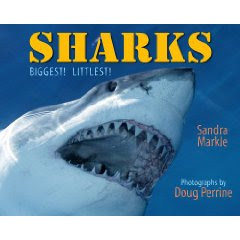
Beyond Jaws: Sharks: Biggest! Littlest! by Sandra Markle

Oh, Jaws is here, all right. After all, a book about the biggest and littlest sharks has to include one of the ocean's largest predators, the Great White, who, with their 100 two-inch teeth, can polish off a seal (or movie actress) before breakfast.

But Sandra Markle's new shark saga, Sharks: Biggest! Littlest!, gives only a passing nod to the Great White, even dissing him a bit, reminding us that he's the puny descendant of the REAL bad boy of the ancient seas, the Megatooth Shark. The rest of her book describes some of the lesser-known and weirder members of the shark family.

Markle begins with those "toothless" giant sharks, the Whale Sharks and Basking Sharks, who cruise around taking in tiny fish and plankton to fortify their huge appetites. Then she turns to some of the most fascinating of sharks, Spined Pygmy Sharks, which fit into a hand like minnows, and the Ornate Wobbegong, whose flubbery head with its protruding skin flaps trailing like seaweed help to camouflage the shark as it rests on the ocean floor and waits for prey.

But perhaps the most curious of predatory styles is that of the Cookie-Cutter Shark:

The Cookie-cutter's eyes are positioned to let the shark look down and keep watch.

When it sees a predator come close, it twists around and bites.

Now the predator is the prey.

The shark's fleshy lips lock on and its long, sharp lower teeth dig in.

The predator's forward motion makes the Cookie-Cutter Shark spin around.

This way, its teeth slice out a cookie-shaped plug of flesh. Then it lets go and swims away fast.

Markle also describes the feeding behavior of some other oddities--the Thresher Shark, who uses his oversized tail to herd and stun his prey; the Longnose Sawshark who uses long whisker-like projections from his extended saw-toothed jaw to feel for small fish hiding on the sandy bottom; and the Swell Shark which discourages predators by inhaling water and blowing up to twice his size. Also featured are the Hammerhead, Horned Shark, and Lemon Shark, in which Markle describes how size and other anatomical characteristics represent the animal's adaptations for finding food in its environment. The author skillfully works in important information about how the shark's skin with its denticles, its continuous replacement of teeth, and its body shape and fins allow for successful predation over its life cycle.

Full-page and smaller color photos, sharp and detailed, extend the text perfectly, making all of the featured sharks memorable to the reader. The basic text is written at a primary level, and, although technical terms (such as denticle and predator) boost the overall reading level to 4.5, these are also defined in the appended glossary. Back matter also includes a full-page world map showing where the featured sharks live, a bibliography, and useful web sites which offer informational photo galleries, videos, slide shows, games, and tips for protecting endangered sharks. This title is equally appealing to elementary readers for browsing or as a source for science reports.

Other excellent illustrated animal books, including more sharks, by Sandra Markle can be found here.

Labels: ,