Going Deep! Smithsonian Readers World of Wonder Level 3

"Sharks have been around for approximately four hundred million years before dinosaurs roamed the earth.
The largest shark that ever lived was the Megladon. This prehistoric predator may have reached sixty feet in length. Fossilized Megalodon teeth measure up to seven inches high have been found."
The third volume in the series, Smithsonian Readers: World of Wonder Level 3
 (Smithsonian/Silver Dolphin, 2015) takes elementary readers deep into the ocean to learn about sharks, deep into the rain forest's shady glades, deep into the eye of a hurricane, deep into the tombs of the Pharaohs, and deep into solar system space to learn all about the planets and their moons. The section on the United States concentrates primarily on famous monuments, national parks, and natural wonders such as the Grand Canyon and Niagara Falls.
Written by author Brenda Scott-Royce, et al, the six subject sections--Sharks, Wild Weather, The United States, The Planets, Rain Forest Animals, and Ancient Egypt, take young independent readers into many diverse areas of intrinsic interest to kids in third and fourth grades, while giving them practice in reading for content with text using a variety of sentence structures, phonics, and wide-ranging terminology. As in the other books in this series, technical terms are printed in boldface and defined in the text, and are also listed in a full glossary at the end of each section. New words and concepts are well supported by multiple colored photos on each page. Self-checking quizzes at the end of each section reinforcement for the information introduced in each section, and punch-out cards provide many opportunities for students to quiz each other on content.

Recommended as supplementary reading for classroom libraries, home-schooling texts, and individual or small-group research, this third volume in the new Smithsonian Readers series offers "engaged" middle graders a change to go deeper into learning about their world, gaining the sort of knowledge that everyone should know.
Auxiliary materials are available in multifaceted activity kits for additional learning by self-directing eager learners.
Labels: Ancient Egypt--History, Planets, Rain Forest, Sharks, United States, Weather (Grades 2-4)
posted by GTC at
12:30 AM
|
0 comments


 (Aladdin, 2012) by Helen Stephens. Kids will cackle with glee as, with their tagalong pooch along for the fun, the Smalls hoodwink their parents and guests, concealing themselves beneath the banquet table, among the legs of the guests, until they get a chance to snatch Teddy from the server, swinging over the feast on a handy and helpfully ornate chandelier. Making use of drapes, convenient suits of armor, sliding panels, trapdoors to secret passageways, and a co-conspirator of a cook, they manage to avoid detection, or at least identification by their parents, and final]y return themselves and Mr. Puddles to their home base, just in time for the expected bed check.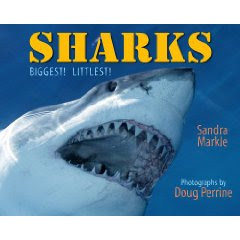
 gives only a passing nod to the Great White, even dissing him a bit, reminding us that he's the puny descendant of the REAL bad boy of the ancient seas, the Megatooth Shark. The rest of her book describes some of the lesser-known and weirder members of the shark family.


 is a fascinating look at the life cycle of sharks, especially the birth and "nursery" period of their young.
 and
and  For more fascinating shark lore, see also Sandra Markle's beautifully illustrated
  and
and 


