Whose? Mine, Mine, Mine, Yours by Kimberly Gee
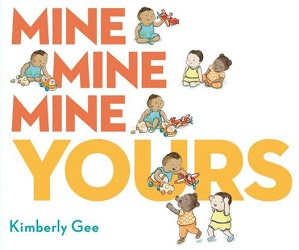
A hopeful young dad welcomes two toddlers over for a playdate, with predictable results.
At first, the tots begin cheerily with a game of hide and seek. Things are going well as Dad searches for the three hiding together under a blanket.
There are giggles and smiles all around as the three walk UP and DOWN over the little bridge and then form a line to walk UNDER it, 1, 2, 3, with Dad playing traffic light.
STOP! STOP! STOP! GO!
There's time for a very messy snack and an individual wash up of hands and faces.They take turns "cleaning up" the kitchen, and the two moms return to claim their little ones after their very first play day with what we can hope will be long-time friends, in Kimberly Gee's Mine, Mine, Mine, Yours! (G.P. Putnam's Sons, 2021). A toddler book which reinforces social skills and the concept of opposites, (beginning with the title), author-illustrator Kimberly Gee's tots and one very busy dad make for quite a story of a first friends-over-to-play-party. Illustrator Kimberly Gee's believable little ones have a charming naivete' all their own, and the story ends with everyone happy.
Share this one with Gee's companion concept book, Up, Up, Up, Down!
Labels: Concept Books, Sharing--Fiction (Ages 1-4)
posted by GTC at
5:55 PM
|
1 comments


Monday, December 13, 2021
What Makes A Family: A House by Kevin Henkes

It all begins with...
A HOUSE.
This one seems simple--but geometically it is more complex than it seems. It's square, with an rectangle for a door and chimney, a circular window and doorknob, and a trapezoidical roof with with overlapping oval tiles. Its door and chimney are a dusty blue, its round window is a pale blue, and the grass is green. There are parallel lines vertically in its shape AND horizontally in its siding and roof.
It's more complex than we might think.
And Kevin Henkes' latest book for the youngest, is not exactly simplistic. It begins as a "concept" book, helping preschoolers practice their shapes and colors, and the celebrated author-illustrator moves seamlessly on to counting. But when an iconic sun and birds appear, concepts of time appear in "morning" and while two birds rest of the roof, young readers are asked to count the number of birds in flight. A similar page for the house at night identifies and counts the moon and stars.
HOW MANY STARS ARE THERE?
The House in rain is pictured with countable clouds and puddles, stressing comparison words like "biggest" and "smallest." The House in snow is next with new snowflakes appearing among raindrops until the house is heavy with snowfall.
The scene is set when Director Henkes calls ACTION!, and a family of five old fashioned Playskool-like people appears with dog and cat following behind.
COMING... HOME.
It takes something really special to make the HOUSE a HOME in Caldecott and Newbery Award-winning author-illustrator, Kevin Henkes' latest, A House (Greenwillow Books, 2021, as Henkes melds the concrete shapes and numbers of the preschool curriculum with the feelings that bring a house alive to be a family home, with flowers up front, a dog in the yard, familiar faces at the window. and yes, a cat on the roof.
Simple but endearing in the way of beloved author-illustrator, Tomie de Paola, this book should become a classic for preschoolers, and a lovely beginning reader for the lower grades.
Booklist remarks that this one does double duty, as it... "invites readers to actively participate in the story, presenting questions about colors and shapes, which quickly become more complex considerations about the locations of objects, visual action elements, time of day, and size comparisons. . . . What started as a fun, interactive visual exercise ends up with a gentle message about family and what truly makes a house a home.”Labels: (Grades Preschool-1), Concept Books, Family--Fiction, Houses--Fiction
posted by GTC at
12:30 AM
|
54 comments
Friday, September 06, 2019
Race Case: The Lost Race Car by Misti Kenison
 Jayden is watching two rather unusual figures flying at colorful kite in his own front yard. What he is not watching is his new toy rolling away! It's a red racer with #15 on its side. Suddenly Jayden notices it is missing!
Forgetting their kite in flight, Detective Fox and Goat are quickly on the case. Fox squints through his telescope and Goat goes into disguise in his dark glasses. Then they spot a car zooming through the garden. Is that the lost car?
NO. THAT POLICE CAR IS WHITE.
That can't be right.
A mighty gray motorcycle roars by. But race cars have four wheels. A cycle has only two. Detective Fox centers his attention on a toy cement mixer on the kitchen counter. Detective Goat ogles the mixer and pronounces it too weighty. A yellow school bus is too long to be a racer. A red and blue toy train travels across the bridge, but it rolls on tracks. Race cars prefer roads. Detective Goat's spyglass spots a red toy vehicle in the backyard, but the tractor is way too tall to be a racer.
Hey! WAIT! What does Jayden's big brother Jordan have it his hand? It's small, it's red, it has four wheels!! Congratulations, Detective Fox and Goat! Case closed.
Some sharp-eyed junior sleuths may well have spotted the lost race car long before the dynamic detective duo do, in Misti Kenison's The Lost Race Car: A Fox and Goat Mystery (Fox and Goat Mysteries)
 (Schiffer Publishing, 2018). Would-be detectives will want to add the salient qualities of various rolling toys shown in Keniston's appendix to their own detective notebooks--color, size, weight, and number of wheels are all clues to solving this case, and some junior gumshoes may have fun making up their own missing vehicle quiz, such as what's white and light? What's long and yellow and has four wheels? What has lots of cars and runs on tracks? Elementary, my dear Watson!
Labels: Concept Books, Mystery and Detective Stories, Toys--Fiction (Ages 2-5)
posted by GTC at
12:30 AM
|
0 comments
Wednesday, August 14, 2019
The Missing Lid Mystery: The Vanishing Baseball Cap by Misti Keniston
 Daniel is on a field trip to the Museum of History. But...
Before he gets in the door, he notices his green baseball cap is gone.
Can he find it? Will he fail?
DETECTIVES FOX AND GOAT ARE ON THE TRAIL!
There are so many history exhibits, and it seems that there are hats in every one!
In the Wild West display, the cowpoke wears a hat, but it's too wide to be a baseball cap. In the sea life tank, the diver's helmet is too big. The astronaut in the showcase wears a hard helmet, and in the early flight exhibit, the pilot's leather helmet is brown.
The early photography exhibit has a figure in a tall black silk hat, but it's way too tall to be Daniel's cap, and the pirate's hat is black and triangular. None of these hats is like his small green cap. The field trip is almost over, and the group is exiting through the gift shop. Is Daniel's cap a goner?
But with Fox and Goat on the case, Daniel's hat turns up, in Misti Keniston's third in series, The Vanishing Baseball Cap: A Fox and Goat Mystery (Fox & Goat Mysteries)
 (Schiffer Publishing, 2019). Kids who keep their eyes peeled through the story will probably spy the missing hat before Fox and Goat do, and to underline the lesson, author Keniston includes a brief appendix with the full rubric of color, size, and shape and texture that underlie the search. This series is great for reviewing the elements of sorting for preschoolers just learning to match characteristics--providing a basic lesson in vocabulary and reinforcing essential skills in math and science and art.
Labels: Concept Books, Hats--Fiction, Mystery and Detective Stories (Ages 2-5)
posted by GTC at
12:30 AM
|
1 comments
Monday, March 25, 2019
Up and Down, All Around: A Parade of Elephants by Kevin Henkes

LOOK!
It's lines of parading pastel pachyderms, papas, mamas, and petite baby elephants, five in each panel.
What are they doing?
They parade on each panel, left to right, trunks up, right to left, trunks mostly down, and left to right again, on each page.
BIG AND ROUND AND ROUND THEY ARE.
ROUND AND ROUND AND ROUND THEY GO.
The elephants enter a cave-like tunnel. In they go and out they come, holding onto each other's tails to find their way.
The elephants parade all day until night is near. YAWN! They trumpet up good night stars and get ready to sleep under them, all five curled up together.
Kevin Henkes' A Parade of Elephants
 (HarperCollins, 2018) is the perfect pachyderm parade for the nursery school set, always five elephants, always in a line, demonstrating up and down, in and out, back and forth, and all those directional concept words that little ones need to describe their world.
 Kevin Henkes, one of the few creators of children's books to have won both Newbery and Caldecott Awards for insightful novels and brilliantly illustrated picture books, gives us inviting, slightly smudgy blackline illustrations filled in with lightly shaded pastel watercolors of elephants marching, marching, marching, through panels on each page to the music of his simple narration, right into a snuggled bedtime under a starry sky of their own creation." Says Publishers Weekly, "With clear, bold type sized for puzzling out letters, this spare offering will appeal to preschoolers who, like the elephants, are settling down to their starry sleep." "A must purchase for all libraries," School Library Journal adds in their starred review.
Labels: Concept Books, Counting Books, Elephants--Fiction, English Language--Study and Teaching (Ages 2-5)
posted by GTC at
12:30 AM
|
0 comments
Monday, December 24, 2018
Concepts A-Board! Numbers Colors Shapes by Roger Priddy

ONE BOAT
TWO RABBITS
THREE BEARS
FOUR DINOSAURS
It's a counting book, counting up to TEN (count 'em) FISH!
But turn the next page and... there are all kinds of colored things! There is an ORANGE carrot and a parrot... and more. And then comes YELLOW ducklings, one banana, and a lemon! And don't forget good old GREEN--leaves, frogs, and grapes. And iconic colors are included: there are PINK flamingos and piglets and BLUE skies and socks!
And then it is time to move on to some basic shapes--squares (like a sandwich) and circles, of course, and then ovals (cf. an egg), stars and diamonds (like a kite).
But there's more than the those standard concepts in Roger Priddy's top-selling padded board book for preschoolers, Numbers Colors Shapes (First 100)
 (St. Martin's Press/Priddy Books). Priddy even takes on emotions and feelings, giving a name to youngsters for SAD, HAPPY, HOT, and COLD . The author even ventures into concepts such as TIME and PLACE, rounding out this popular concept and vocabulary-building little board book, mixing colorful illustrations and photographs, making this one a concept book that grows from crib to Kindergarten days, especially if bundled with Priddy's hit First 100 companion books, First 100 Words
 and First 100 Animals.
Labels: Colors, Concept Books, Counting Books, Numbers, Shapes (Ages 1-5)
posted by GTC at
12:30 AM
|
1 comments
Saturday, March 31, 2018
Dinos Teach Differences: A Stampede of Dinosaurs: A Clever Opposites Book by Kimberley Farrah, et al
 It's a parade, a march, even a stampede, as dinosaurs stomp across the pages, in clusters and squads, huddles and piles, What's going on here?
What is going on is a jolly lesson in comparison, one of those concepts that preschoolers need to master, and these fanciful dinosaurs arrange themselves into groups for that purpose. Three dinos become a tall squad, the opposite of a pile of short, sleeping dinos. Some dinos climb, while some slide down.
Slow dinosaurs plod along, Fast dinos pass in a flurry of blurry speed.
Picture Fit Board Books: A Stampede of Dinosaurs: An Opposites Book
Labels: Concept Books, Dinosaurs--Fiction, Opposites (Ages 2-5)
posted by GTC at
12:30 AM
|
0 comments
Sunday, March 18, 2018
Caterpillar's Colors: The Very Hungry Caterpillar's Easter Colors by Eric Carle

Little kids are learning all the time, and what time is better than Eastertide for learning the colors? Nature is switching from basic black, gray, and white to a rainbow of colors, and what better teaching experience is there than being immersed in color while dyeing Easter eggs for the Easter basket?
And Eric Carle and his beloved character, that hungry little caterpillar, are the perfect guides, in his board book, The Very Hungry Caterpillar's Easter Colors (The World of Eric Carle)
There's a PINK flower, a BROWN bird's nest, and a woolly WHITE lamb who get the same double-paged spread, and there's a surprise on the last two pages--a Happy Easter basket showing off all the colors in its bright eggs. This jolly board book is just right for the basket, something that will be around long after the chocolate eggs are nibbled.
Labels: Colors, Concept Books, Easter--Fiction (Ages 2-5)
posted by GTC at
12:30 AM
|
0 comments
Saturday, August 26, 2017
What Comes Next? Before And After by Jean Jullien
 Who doesn't want to know what comes next?
Start with a bunch of dry spaghetti. What comes after that steaming pot? A big, steaming plate of pasta!
What comes after a head of dirty, disheveled hair? (Hopefully?) A comely coiffure!
What comes after a freshly-laid egg? A chicken! (Okay, maybe a baby alligator or a tadpole or an ostrich. ) You get the idea.
What comes after a pale sunbather? A painful sunburn (unless you use plenty of sunscreen, of course).
What comes after the front end of a dachshund? The END.
Jean Jullien's latest, Before & After

The author even offers what happens in between the beginning and the end, as a dad and boy board a roller coast, ride with hands in air bravely during the first big drop, and finish the ride with Dad, dazed and windblown and boy with a great big smile. Jullien even offers a final joke, with her back cover showing what happens after that double-dip ice cream cone shown on the front cover, with her trademark little dachshund greedily lapping up the dropped scoop of strawberry ice cream. This one is a little tour de force of a concept book that offers learning and fun with each page turn.
Labels: Concept Books, Time--Fiction (Ages 2-5)
posted by GTC at
12:30 AM
|
0 comments
Monday, July 24, 2017
Point A to Point B: Transportation: How People Get Around by Gail Gibbons

Transportation is what people use to get around. They choose what works best to get from place to place.
From heels to wheels and wings, humans have always been on the move from here to there. But there are probably more ways these days than ever.
Still Gail Gibbons, the queen of concept books, gamely gives her best try to categorize and describe all the many ways people change places.
In her latest, Transportation
 (Holiday House, 2017), author Gibbons divides her task into a veritable taxonomy of transportation--Cars and Vehicles, Trains, Boats, and Aircraft.
Within each class, artist Gibbons offers clear blackline illustrations of various vehicles, mostly shown in profile for easy identification. Gibbons' straightforward line drawings are both simple and detailed, making distinctions, for example, between automotive vans and SUVs, and even distinguishing between compact cars, coupes, middle-sized sedans, hatchbacks, station wagons, luxury sedans, and stretch limousines.
Riding the rails, Gibbons describes the variety--subway trains, elevated trains, commuter trains, freight trains, passenger trains and high speed bullet trains. As for water transportation, there are canoes and kayaks, sloops and submarines, water taxis, cruise ships, rowboats, ferries, and ocean liners, and her aircraft include single-engine airplanes, freight carriers, passenger airplanes--from puddle-jumpers to transoceanic airliners--and even vehicles that travel to the border of outer space at the International Space Station.
A non-fiction book that provides both clear visuals and vocabulary-building text, this book is a good-sized, go-to compendium for motorhead fans to browse and for those early childhood education class units on transportation.
Labels: Concept Books, Transportation, Vehicles (Grades Preschool-3)
posted by GTC at
12:30 AM
|
2 comments
Friday, September 19, 2014
All Together Now! Colors Vs. Shapes by Mike Boldt

"WE ARE GOING TO SHOW YOU HOW GREAT SHAPES ARE!"
"WAIT! WAIT! WAIT!
YOU SERIOUSLY THINK YOU'RE MORE TALENTED THAN WE ARE?
THIS BOOK IS ALREADY SQUARE!"
The talent competition on stage has just begun, and already the contestants are duking it out for the spotlight.
A crusty old alligator, acting as judge, tries to enforce some order, as the blobs of color rush forward to strut their best stuff.
"FOR STARTERS, STEP BACK AS BLUE AND YELLOW MIX IT UP!
HELLO, GREEN! ENVIOUS?"
But the shapes are not intimidated. They push their way to the front of the stage as two triangles bounce off a trampoline and, ta dum! land as...
A SQUARE!
And it's game on, in a match of Can You Top This? as the Shapes and Colors vie for applause.
Blue and Red make Purple! And the Shapes counter, adding a few more triangles. Voila! A Pentagon! A Hexagon!
The colors go wild, blending into a kaleidoscope of pink and turquoise and maroon and amber all over the stage.
The shapes knock themselves out, morphing into a nonagon, a rhombus, and, egad! An irregular polygon!
The colors and shapes get all mixed up on stage, and then...
SPLAT!
The Unthinkable occurs. RED and OCTAGON collide! The Unthinkable becomes SOMETHING NEW!
Realizing the possibilities that their combination makes actionable, the combined colors and shapes sort themselves into a whole multi-hued cityscape, with trees, houses, skyscrapers, a ship, and even a rainbow! Shapes take on colors, and each color takes its shape.
Everybody is a winner in Mike Boldt's latest concept book, Colors versus Shapes
 (Harper, 2014), a novel way to teach the basics (and the not-so-common) colors and shapes while slipping in a small plug for cooperation. Pair this one with Boldt's comic companion book, 123 versus ABC
 for more competitive concept fun.
Labels: (Grades Preschool-2), Colors--Fiction, Concept Books, Shapes--Fiction
posted by GTC at
12:30 AM
|
0 comments
Wednesday, May 08, 2013
Flap! Flap! Flaps! UP! TALL! and HIGH! by Ethan Long

"I AM TALL!"
A clearly self-important green bird proudly boasts about his height until an even taller lavender bird walks on page, towers over him, and tells him so.
But both birds seem to have been topped by a third set of long bird legs. The two birds stare up and up and up, and the page turns to reveal a half-page gatefold revealing the third bird, actually quite squat in stature, standing on a very long pair of stilts. AHA! But before the tall two can protest, the short bird hops down, admits that he's not actually tall, but gets the last word as he spreads his very impressive tail to prove that he's can best them both in the horizontal department:
"I AM NOT SMALL!"
Artist-animator Ethan Long's 2013 Theodor Seuss Geisel Award-winning book, (for beginning reader books) Up, Tall and High
 (Putnam, 2013) takes on the task of explaining the difference between the related but not synonymous concepts of "up," "high," and "tall." You can be small and high, or tall and up, but not necessarily high (or at least not the highest!) and Long's three short stories, which add up to only 34 words in total, demonstrate these slightly different concepts through the use of opinionated birds and the use of half-page gatefold flaps which demonstrate the concept while provoking some chuckles at these boastful birds who are obviously high on themselves.
 Great for toddlers just learning the fine points of language or for older emergent readers who will proudly read this book to themselves, Long's little linguistic lesson offers youngsters the sort of silly slapstick story preschoolers love. Or, as Publishers Weekly puts it ... "borscht-belt clowning by the birds provides plenty of visual humor."
Labels: Bird Stories, Concept Books, Toy and Movable books (Ages 1-4)
posted by GTC at
12:30 AM
|
0 comments
Wednesday, November 30, 2011
At Your Fingertips: Press Here by Herve' Tullet

READY?
PRESS HERE AND TURN THE PAGE.
At a touch of the forefinger and a flip of the sturdy page, the one yellow dot has become two.
Who could stop now?
Another firm press and the two become three. Then a gentle rub on the one on the left and presto! The yellow dot on the left is now a RED dot. Well done! Now, an equally gentle rub on the yellow dot on the right and...it is now BLUE. Three dots, Red, Yellow, Blue, now await the next command.
Five quick taps on the yellow button brings a new vista: three rows of five dots, one yellow, one red, one yellow. one blue. Perfect!
But wait, there's more. Shake the book and you get a random arrangement over a double-page spread. Tilt the book and the dots slide to the top, to the bottom, and from side to side of the two pages. Wipe the page and the following double page is black.
No problem. Press all the dots and the lights come back on. Clap your hands--not too loud!
WHOO-HOO! KEEP CLAPPING!
Herve Tullet's innovative Press Here (Chronicle Books 2011) has snowballed into a runaway best-seller since its publication earlier this year. A deceptively simple-appearing board book with thick bright pages ornamented with a series of almost round dots which take on a life of their own, proving that flat pages which inspire the imagination can be truly interactive, while achieving a conceptual sophistication which teaches both number sets and color along the way. As recent picture books have shown, the genre is far from dead, taking elements freely from electronic media and going them one better! It's not MAGIC. It's a BOOK!
"Without so much as a single tab to pull or flap to turn, this might be the most interactive picture book of the year," said Booklist in its review.
For a glimpse of the magic, see the book's trailer here.
Labels: Colors (Grades Preschool-3), Concept Books, Numbers
posted by GTC at
12:01 AM
|
1 comments
Sunday, September 04, 2011
Pre-K Primer: Everything I Need to Know Before I'm Five by Valerie Fisher
 Every once in a while the right book comes along at the right time. Just in time for the first day of Kindergarten we have Valerie Fisher's brand-new Everything I Need to Know Before I'm Five
Fisher's jellybean-colored, Walter Wick-like photos of toys--trucks, rubber duckies, dinos, miniature dolls--and found-object yard-sale bric-a-brac are eye catching, humorous, and illustrative of the concepts presented on each bright white page. For example, in the series show opposites, two plastic doll figures demonstrate "EASY" standing simply with arms out and "HARD" in the same pose but balanced in a precarious handstand. In the series demonstrating "PUSH" and "PULL" these same versatile dollies shove along a fat green frog bigger than they are. Blocks spell out colors as well as show them, and novel plastic figures such as a flamingo portray the letters of the alphabet. Kids will pore over these ingenious illustrations on their own as they unconsciously absorb the ideas and terms behind the retro-styled photos.
Reviewers rave and buyers brag over the merits of this little concept book, with Publishers Weekly awarding it a starred review. If you have a rising Kindergartner or precocious preschooler (and aren't they all!) around the house or know of one, this is a must-have.
Labels: Alphabet Books, Colors (Ages 2-4), Concept Books, Numbers
posted by GTC at
12:01 AM
|
0 comments
Sunday, January 16, 2011
Dotty about the Spotty? Lots of Dots by Craig Frazier

SOME DOTS ARE BIG.
And some books, like Craig Frazier's Lots of Dots,
SOME DOTS ARE SMALL.
SOME DOTS FLOAT.
AND SOME DOTS FALL.
Sure, it sports an eye-catching cover, with an amorphously-shaped, clown-like figure apparently juggling colorful balls, and inside its bright, primary colored illustrations are innately appealing and its spare text, one line per page, turns out to form pleasantly rhythmic quatrains.
But break out all this content and you have a book of wide appeal and many uses. The "dots" are actually circles, which in the author-illustrator's imagination can be many things: drums (big), dots on a ladybug's carapace (small), soap bubbles (floating), and apples (falling), so that this book becomes a useful shapes concept book throughout. These dots can be scoops of ice cream for licking or balls for kicking, a sun shining or wheels for skateboard fun. After one run-through of this book, toddlers will be able to point out the dots on each page and older kids will want to spot "dots" everywhere, indoors and out, just as the book promises. (How many circles can we spot while we walk down this block?) Frazier helpfully finishes up the book with a double-page spread of just such "dotty" shapes from everywhere to spark your own I-spy game.
But, wait! There's MORE! The human figure assumes a different color on each page, making each page an opportunity for teaching color concepts to youngsters. (Name all the colors on this page!) Older kids, having heard the first quatrain, should be eager to guess what the second set of rhyming "dots" are going to be. (Can we make up a brand-new four-line rhyme about circular things for ourselves? It's easier than you think...)
Some dots are soft (marshmallows).
Some dots are hard (dinner plates).
Some dots are inside (sofa pillows).
Some are in the yard (soccer balls).
You don't have to be poet laureate to dash off a few among yourselves, and that's always a good time to talk about rhyming words; after all, if you figure out one, just change the beginning letter and you can read them all. Hey, you're teaching reading here!
Thinking skills? How many "dotty" things to eat can we name? Cheerios, marshmallows, carrot pennies, gumballs? What "dotty" things do we wear? Buttons? Rings on our fingers? Holes for our shoelaces? Bracelets? Ponytail holders? How about artwork? How about a collage of "dotty" things cut from old magazines? What "dotty" things can we make from play clay? Snowmen, anyone, with little "dots" for facial features and buttons down his front? There are lots of possibilities with this clever little book at your fingertips.
As a bonus, Frazier's text is easy enough for lapsitting tots to follow with cues from the adult reader, but basic enough for beginning readers (thanks to the rhyming words) to breeze through on their own.
In other words, Lots of Dots,
Labels: Colors, Concept Books, Shapes, Stories in Rhyme (Ages 1-6)
posted by GTC at
12:01 AM
|
1 comments
Sunday, March 30, 2008
Do The Math! Each Orange Had 8 Slices by Paul Giganti
 It's time for a fresh look at a great concept book, Paul Giganti's Each Orange Had 8 Slices (Counting Books (Greenwillow Books))
The text begins with a simple numerical statement:
On my way to the playground
I saw three red flowers.
Each red flower had
Six pretty petals.
Each petal had two tiny
Black bugs.
How many red flowers were there?
How many pretty petals were there?
How many tiny black bugs where there in all?
The text continues with waddling ducks, fat cows, and--picture books, the last page of which presents that traditional mathematical riddle-rhyme on which this book is based.
As I was going to St. Ives,
I met a man with seven wives.
Each wife had seven sacks;
Each sack had seven cats;
Each cat had seven kittens.
Kits, cats, sacks, and wives,
How many were going to St. Ives?
(Don't forget to count the man!)
Caldecott artist Donald Crews' bright abstract gouache illustrations work perfectly with Paul Giganti's text to provide a book with almost endless ways to have fun with number concepts, whether it is simple counting, an introduction to multiplication, or higher concepts. Each Orange Had 8 Slices (Counting Books (Greenwillow Books))
belongs on every kid's bookshelf, at home or school.Labels: Concept Books, Counting Books, Mathematics
posted by GTC at
12:01 AM
|
8 comments
Sunday, July 15, 2007
Seeking the Reclusive Rackhead: Elusive Moose by Joan Gannij
 Did you know that there are moose in Russia? And that an Alaskan moose's rack can be six feet wide? That frogs are found on every continent except Antarctica? The appendix to Joan Gannij's Elusive Moose
A Hide-and-Seek lap book, Elusive Moose In the midwinter scene, his just-shed antlers lie discarded in the snow, but only his departing feet may be seen.
"I've tracked down moose hoof prints
On land white with snow.
I've seen Arctic foxes
And hares come and go.
But moose are elusive.
Moose roam where they please.
I wish I could see one
Just once. May I, please?"
At this final request the elusive moose appears, stepping out of the evergreens with a big smile on his face.
Toddlers and young preschoolers will love spotting the reclusive moose hiding in the background of each page and will learn the names of other wild animals as they trek through the woods following the tracks of the elusive moose.
The wonderful art and rhyming text make this book one that children will request over and over, and the back matter gives the parent or teacher many ideas to continue the nature experience.
Labels: Animal Stories, Concept Books, Stories in Rhyme (Ages 1-5)
posted by GTC at
12:01 AM
|
1 comments


