Yay, Us! Pete the Cat Rocking Field Day by Kimberly and James Dean

The sun is BRIGHT and the grass is GREEN. It's a great day for ... FIELD DAY!
LAST YEAR, PETE'S TEAM CAME IN THIRD PLACE.
HE WANTS TO WIN FIRST PLACE THIS YEAR!
Pete wears his red tee, his red headband, and of course, his good-luck red shoes.
The teams line up for the first competition, the baton pass relay race. On the other team are Alligator, Marty the monkey, Squirrel and Turtle.
OH, NO! Squirrel is faster than anyone and hands the baton to Turtle, who crosses the finish line first! Pete knows that they have to try harder, and in the water balloon toss, Pete and Callie win for their team.
The teams are tied, and Pete knows that he still has a chance to earn a medal. But can Pete and his team win the next three events?
Pete's team is fired up! They win the rope pull, and Pete aces the obstacle course. Pete knows he'll get a medal if he can just win the egg-carry race.
Will Pete's hand stay steady...
Or will his nerves (and the egg) crack? OOPS!
It's a tie for the two teams, and Pete has to accept his medallion with a bit of (metaphorical) egg on his face, in Kimberly and James Dean's
Pete the Cat: Rocking Field Day (I Can Read Level 1) (Harper I-Can-Read Books.
Everyone is the winner when youngsters become eager readers, and as Pete always says, "It's all good!" And everybody's a winner when the class has a great day outside and when kids can read about the games all by themselves in this winning I-Can-Read easy reader book.
Labels: (Grades Preschool-3), Beginning Readers, Field Day--Fiction, Friends--Fiction, School Stories
NO HELP WANTED! Peter Easter Frog by Erin Dealey

"HERE COMES PETER EASTER FROG,
HOPPING DOWN HIS FAVORITE LOG.
"HIPPITY HOPPITY, EASTER'S ON ITS"--
CRASH! Peter Frog smacks into Turtle, who points out the obvious, that the worst bunny in the woods is more warm and cuddly than even the most enthusiastic ectothermic amphibian!
"HEY! YOU'RE NOT THE EASTER BUNNY!!!"
But Peter Frog insists that he has qualifications. For one thing, he can hop as far as the Easter Bunny. Unabashedly he begins to compose his own theme song about an Easter frog slogging through the bog, squishity-squashity--well, you get the idea!
"WHY SHOULD BUNNY HAVE ALL THE FUN?"
And the other animals seem fired up about getting into the egg-delivery gig. Cow offers to carry the Easter basket, hooked on one horn, and Turtle takes a ride on Cow's wide back. Sheep Dog and a few of his followers flock to join the procession, along with a ground squirrel who claims he specializes in hiding things. Hi Ho, Hi Ho! It's down the road they go behind Peter Easter Frog until they come to an underpass, where at the end of the dark tunnel they see.... a burly Easter Rabbit with a basket and a big scowl!
"PETER WHO-DEE WHATTTT??"
"I am THE BUNNY!"
But all's well that ends with a happy expansion of the Easter-egg delivery franchise, in Erin Dealey's Peter Easter Frog, with one unusual but successful Easter Rabbit apprenticeship program successfully completed. Award-winning artist G. Brian Karas provides the comical mixed media illustrations which portray a finally happy Easter Day and give kids some giggles along the way in this unusual Easter Rabbit tale. Says School Library Journal, "A great addition to Easter book collections for the youngest readers."
Labels: Easter Bunny--Fiction, Frogs--Fiction
(Grades K-3)
Wind Song! Biscuit Flies A Kite by Alyssa Satin Capucilli

It's MARCH! The Earth has come a long way since the fall solstice signaled the advent of cold days, but now the days are creeping close to the spring equinox with longer--and warmer--days. Spring cometh soon, but first--March winds do blow! What should kids do?
Right! GO FLY A KITE! And Biscuit and his fellow pet Puddles are taking their girls outside to give it a try. They have bright-colored kites with long, long strings wrapped around a stick to hold them by, that is, if they can get their kites UP.
But first the pets have to try to play with the sticks and run away with them. Biscuit and Puddles get the kite strings all tangled up.
The girls are patient with their pets, and when the strings are untangled, it is time to try to get their kites to catch the wind.
READY?
HERE COMES THE WIND!
But the two kites are stuck on the launching pad. (Well, actually--stuck on a bush!) Time to try again. Hopefully, the girls jump to toss their kites high to catch the wind.
WOOF!
BOW WOW!
But their strings snap in a gust of wind and only the fast moves of Puddles and Biscuit save the day--with historic leaps to catch the trailing strings!
PUDDLES CAN JUMP HIGH!
But the girls give it one more try... And the third time is the charm for the two girls and their pets. They have LIFT OFF, in Alyssa Satin Cupucilli's salute to March winds in her Biscuit Flies a Kite (My First I Can Read), (HarperCollins) with the help of her artistic partner, Pat Schories, in this breezy seasonal My First I-Can-Read book for young dog and book lovers. It's time for the two plucky girls and their pets to lean back on a park bench and admire their kites flying high in the spring breeze. As always, Biscuit is there for memorable childhood occasions for young beginning readers.
Labels: (Grades Preschool-2, Beginning Readers, Dogs--Fiction, Kites--Fiction
Signs of Spring! Happy Springtime by Kate McMullan

At about this time year, on the sidewalks around primary and elementary schools, less-than-perfectly straight lines of warmly-dressed young scholars may be seen trudging behind teachers on a slow-moving walk, interrupted often by someone pointing or darting out of line to pick up unknown objects and scanning the skies and trees nearby. They are re-enacting one of the oldest rites of human life, the expectant search for SIGNS OF SPRING!
HERE'S A MESSAGE FOR SCHOOL BUS RIDERS, HEADING OUT ON A DARK COLD MORNING...
FOR THOSE WITH STUCK SNOWSUIT ZIPPERS...
WEARING EARMUFFS AND TWO PAIRS OF MITTENS...
DO NOT LOSE HEART!
For beneath their very feet the earth is continuing its annual circuit of the sun. Each day is longer than the one before, and the chilly, muddy earth under their boots is preparing for its really big show of the year!
Primary scholars are not the only ones waiting for Mother Earth's biggest EXTRAVAGANZA...
GROGGY FROGS WAKING FROM THEIR WINTER SLEEP, TREES UNFURLING LEAVES, PINK WORMS POKING UP...
WINTER-BORN BABIES WHO'VE NEVER SEEN A SPRING....
Everyone celebrates that time that ancient astronomers watched for, that EQUINOX, that time when days begin to grow longer than nights, when grass grows so fast you can almost see it doing it, little birds take their first flight, bikes, shorts, and running sneakers appear along with the crack of the baseball bat, and spring peepers in the pond where picnickers watch, and birdsongs begin provide the background music until...the big day arrives--SUMMER SOLSTICE.
SO LONG SPRINGTIME,
SEE YOU NEXT YEAR!
Spring never fails to delight us, no matter how many we've seen, and noted author Kate McMullan joyfully traces in lyrical language its progress through the landscape and into our consciousness every year. Watch and ... Wait for it!
Illustrated exuberantly by artist Sujean Rim, this is a great book to get youngsters observing the signs of Earth's heralded big production each year, in Kate McMullan's Happy Springtime! (Neal Porter Books/Holiday House, 2021). In a perfect melding of narration and illustration, it's a breath of fresh air for the winter-weary brain. Says School Library Journal, "Rim's watercolor, pencil, crayon, and collage illustrations are lush and fluid like snow melting into the new growth taking its place. These blend beautifully with McMullan's springtime celebration, warming the fingers, toes, and hearts of readers."
Labels: Spring--Fiction, Vernal Equinox--Fiction
(Grades Preschool-3)
It's How You Play The Game! The Thing Lenny Loves Most About Baseball by Aaron Larsen

IT'S SPRINGTIME IN THE PARK.
"ONE DAY I'M GOING TO PLAY IN THE BIG LEAGUES," SAYS LENNY, THROWING THE BASEBALL.
"I'LL BE THERE CHEERING FOR YOU," SAYS HIS DAD, CATCHING IT."
Lenny likes to read up on baseball. That night he tells his dad about a game that lasted for two days.
"IT COULD HAVE GONE ON FOREVER," SAYS LENNY. "I LOVE THAT ABOUT BASEBALL."
In the first game, Lenny gets under a hit to the outfield. He runs back and forth, trying to find exactly where it will fall. But the ball drops to the grass right beside him. Lenny is embarrassed to be afraid of the ball. But he keeps studying about the game, and he's consoled when he reads that home-run heroes Babe Ruth and Hank Aaron had many more strikes than hits out of the park.
"I LIKE THAT ABOUT BASEBALL." HE SAYS.
Lenny tries playing catch in his Greek warrior helmet for protection from the ball, but it doesn't help. Lenny tells himself he's going to miss more than he catches, and he's right. But he keeps on practicing and he keeps on getting better. He tries to remember the old adage to "keep your eye on the ball."
And at the next game, with the score tied in the last inning, there's a hit to the outfield. Lenny goes deep, deep, and when the ball comes down, he's there....
THWAP!
It drops right into his waiting glove!
And when the girl who's up to bat first in the next inning hits it out of the park, Lenny remembers the old saying, "You win some. You lose some."
And the old adage is right: it's not whether you win or lose. It's how you play the game, in Andrew Lewis' latest, The Thing Lenny Loves Most About Baseball,(Kids Can Press, 2021).
It's true that "You can't win 'em all," but you can improve your game and enjoy the gameplay, as Dad models and Lenny learns in this story of the right way to play summer league baseball. You can't always win and you won't always be the star, but Lenny's jolly red-bearded dad teaches his son how to play a team sport for the fun of it--just in time to get ready for the start of the spring baseball season.
Says Kirkus Reviews, "... A good counter to the insistent, invidious message that winning is all that matters."
Labels: Baseball--Fiction, Father and Son--Fiction.
(Grades Preschool-3)
From Seed to Glow! How to Help A Pumpkin Grow by Ashley Wolff

Where do pumpkins come from? A packet of freeze-dried powder? A can of orange glop? The frozen dessert section of the grocery?
No! Pumpkins come from pumpkin seeds! Cut off the top of any pumpkin and you'll see them, clustered together inside the pumpkin--seeds that came from a pumpkin patch somewhere on earth!
And how do we get pumpkins for Halloween Jack-O'-Lanterns and Thanksgiving pumpkin bread and pies and those ubiquitous pumpkin-spice flavored smoothies? We plant pumpkin seeds in early spring! And that's what author-illustrator Ashley Wolff shows us how to do in her just-in-time pumpkin-planting book, How to Help a Pumpkin Grow (Beach Lane Books, 2021). A helpful black and white Aussie dog recruits some friends and shows them how to cut a lid off the top of a pumpkin and separate the seeds from the glop inside to dry them for planting in the pumpkin patch.
DIG IT!
SEEDS TO SOW.
Protect them from the falling snow! Fence them and chase away a marauding crow. They like a bit of fertilizer and plenty of water from time to time. When the tender stalks and leaves begin to show, fence in the patch so their vines can go! Co-opt the bunnies and geese and goat to let the vines and tiny pumpkins just GROW..., losing their green color and gaining their orange glow!
FILLING UP THE GARDEN--WHOA!
When the big green pumpkins turn to orange, it's time to roast the seeds, to mix the filling, and bake the pies in the oven.
IT'S TIME TO CARVE THEM JUST SO!
Light the candles and watch them--
"GLOW!
With bouncy rhyming text and jolly illustrations of all kinds of friendly animals collaborating and cooperating to produce pumpkin treats together, this lovely book written and illustrated by Ashley Wolff does double duty for fall read alouds. After all, where do next year's Jack O'lanterns and pumpkins pies come from?
Share this one with Margaret McNamara's How Many Seeds in a Pumpkin? (Mr. Tiffin's Classroom Series), reviewed here:
Labels: (Grades Preschool-3), Gardening--Fiction, Pumpkins--Fiction, Stories in Rhyme
Good Things in Small Packages: How Many Seeds in a Pumpkin? by Margaret McNamara
 Charlie is the smallest kid in the class, and because Mr. Tiffin lines his class up by height, he's always last and least!
But then, "one chilly fall morning," little Charlie arrives at school to find three fine pumpkins, one large sized, one medium, and one, well, rather small pumpkin lined up on the table at the front of the classroom. When Mr. T. challenges his class to guess which one has the most seeds inside, Charlie is too timid even to hazard a guess.
But when the "messy business" of separating the seeds from the slimy stuff inside the three pumpkins is done, there are "three empty pumpkins and three full bowls" of pale yellow seeds to count. Amazingly, it's the smallest pumpkin, by a small margin, which turns out to be the pumpkin with the mostest!
"Small things have a lot going on inside them!" Charlie points out, and Mr. Tiffin agrees, lining the class up smallest to tallest, with Charlie leading the way to lunch.
In her new book, How Many Seeds in a Pumpkin? author Margaret McNamara provides a lot of pumpkin science (e.g., pumpkins with a lot of vertical lines have the most seeds), pumpkin math (counting by twos, fives, and tens), with a bit of values learning as well, with the reminder that physical size isn't the whole story--in pumpkins or in people!
Also known for her similarly themed book, The Pumpkin Patch, McNamara is ably supported by the illustrations of G. Brian Karas, (Muncha! Muncha! Muncha!). Their new book comes along just in time to be a worthy addition to older seasonal standbys for pumpkin picking, pumpkin decorating, pumpking carving, and pumpkin pie baking time in the primary grades.
Labels: Pumpkin Stories, School Stories (Grades Preschool-3)
Spring Thing! Carpenter's Helper by Sybil Rosen

THE NEW BATHROOM IS HALFWAY FINISHED!
In her overalls and yellow safety helmet, Renata is happy to be helping Daddy. They are refurbishing their bathroom with a fancy oval window and a big old-fashioned bathtub with fancy legs.
SHE CAN ALREADY PICTURE THE CASTLES OF BUBBLES SHE WILL BUILD IN IT.
Renata carefully holds the bracing board as Dad nails it up to support the place where he will cut out the new window! With interest she peeps inside the walls at the pipes and wires inside.
But it is early spring, and Renata's is not the only family working on a new house. After one night, when Daddy leaves the new window space uncovered, Renata's discovers that a pair of wrens seem to be building their new house on the bottom shelf over the tub in her bathroom. Daddy's bathroom makeover has to come to a halt while the bird parents build a snug and comfy nest of leaves, grass, twigs.
And just as soon as Mama Wren lines the nest with soft moss and a squiggle of ribbon for decor, she beds down in it and soon lays four red-brown eggs.
"WE WON'T BE ABLE TO WORK NOW," SAID HER FATHER.
"CAN YOU WAIT THAT LONG FOR YOUR BUBBLE BATH?"
"I CAN WAIT!" RENATA SMILES.
Soon the baby wrens hatch and peep, while the parents fly back and forth through the window with take-out baby bird food to keep the babies growing in their little nest on the shelf.
SOMETIMES PAPA WREN SITS IN THE WINDOWSILL AND SINGS AND SINGS!
And when the little wrens are ready to fledge, Mama and Papa Wren sit in the window frame and churr to the babies to fly to the window and outside with them. But the babies are not able to fly all the way, and all four of them wind up making emergency landings in Renata's big bathtub! Thinking fast, Renata grabs a small plank and puts one end in the bathtub to make a bridge for the fledgelings, and soon they are up and on the wing to the warm spring scene outside, in Sybil Rosen's just published Carpenter's Helper (Schwartz and Wade, 2021).
With this beguiling story of a unusually patient girl and her dad, brought to life with the delightful illustrations done in colored pencil and soft palette by artist Camille Garoche, this is an unusual picture book that utilizes a loving parent-and-child and parallel avian family relationship, a sweet baby bird rescue story filled with the warmth of love and spring.
Says Publishers Weekly's starred review, "Excelling in natural illustrations with a slightly cartoonish bent, Garoche offers fine-lined colored pencil art done digitally in a soft color palette. This gentle story, with its respect for family, nature, construction, and collaboration, will lift readers’ spirits as surely as Renata boosts the wrens.”
Labels: (Grades K-3), Birds--Fiction
Building--Fiction
Nests--Fiction
What's the BIG Idea? Twenty Big Trucks in the Center of the Street by Mark Lee
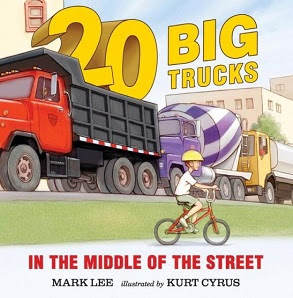
On a sunny, tree-lined city street, a boy bikes through the park. And then something happens!
ONE ICE CREAM TRUCK, SELLING EVERYTHING SWEET,
BREAKS DOWN AND BLOCKS THE MIDDLE OF THE STREET.
And before the vendor gets out to check under the hood, the mail truck comes along and stops behind him.
And one after the other, more trucks are stopped behind them--even a truck with bales of hay! Looks like nobody's going anywhere today!
And behind him, others stop--a pick-up truck full of landscaping trees, a giant yellow crane truck, delivery trucks of all kinds, two moving vans (who won't be moving), a stake truck of pigs, and a dump truck loaded with sand. Two traffic cops show up, but they're no help. Nobody can back up or go forward. Meanwhile, a cement mixer and a gasoline tanker pull in behind. Next come a tar truck and a truck for towing; nobody here is going to be going.
A garbage truck, a bread truck, a truck full of meat, no is moving on this street. Everybody frets, without a clue. There must be something somebody can do!
A small voice speaks up--the kid on the bike. At first they ignore him, then realize he's RIGHT.
PLEASE LOOK! CAN'T YOU SEE?
THE BIG CRANE TRUCK IS WHAT WE NEED!
And suddenly the stalled crane operator swings his boom over the others and lifts up the ice cream truck, swinging him down to the grassy park's side, leaving the others to continue their ride.
And with the ice cream truck open for business in the park, the boy gets a free ice cream cone, in Mark Lee's latest, Twenty Big Trucks in the Middle of the Street (Candlewick, 2022). Author Mark Lee lets the youngest bystander save the day and help everyone else be on their way, Kids get to polish their counting skills as well in this reading treat, and illustrator Curt Cyrus adds to the fun with his realistic vehicle drawings, All's well that ends well (and with ice cream for all comers.)
Writes the Wall Street Journal's reviewer, "Handsome entertainment. This softly rhyming picture book presents children with a small but exciting dilemma that quickly involves—hurrah!—all sorts of trucks.
Labels: (Grades Preschool-2), Counting Books--Fiction, Ice Cream--Fiction, Stories in Rhyme, Trucks--Fiction
A Boy And His Dog: This Day by Juliana O'Neill
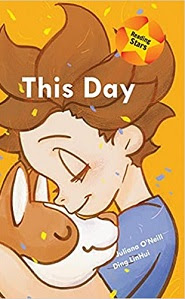
A little-golden and-white Corgi wakes his boy, snoozing deeply in his warm bed.
TIME TO PLAY!
And play they do!
First they take a dip in the pool, the boy with his snorkle and mask, the dog in in his doggie life jacket, as the sun sparkles on the water. Then they climb out and seek the warmth of the tent, creeping into the sleeping bags inside, and then move to the soft, warm grass to to sprawl on their backs to soak up some rays in the sunshine.
And when they are warm and dry, it's time for a good walk together, a friendly talk, and reading a dog story with their friends.
And soon it's time for to curl up together as Mom spreads the coverlet over both of them after the best sort of day ...
...
A DAY OF PLAY.
There are only 23 choice sight words in Juliana O'Neill's early reader about a companionable day with a boy and his dog,
This Day (Reading Stars), (Xist, 2022). Beautifully muted soft pastel illustrations by artist Ding LinHui, provide the visual cues in his illustrations which help early readers "read" the 23 sight words in this soothing early reader. What a way to spend a day!
Labels: (Grades Preschool-1), Dogs--Fiction, Pets--Fiction
Beware! Cat Traps by Molly Coxe
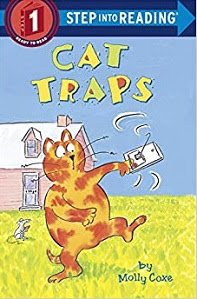
For a big orange cat, there is nothing sadder than an empty bowl.
CAT WANTS A SNACK.
He snickers as he locates the perfect device--a spring-release mouse trap! But the trap does not catch a mouse.
CAT CATCHES A BUG!
YUCK!
Down near the chicken coop, Cat tries another idea, a wire cage with the door propped open. The chickens cluck all around it and then stroll off, free, but Cat's trap catches a pig.
TOO BIG!
Cat really wants a snack. By the pond, he tries to catch a fish in a net. The fish is so big that it tows him around the bend in the net
Next, the poor hungry cat strikes out with deadfall trap for a bullfrog and gets an angry dog instead. Then he nets a duck. You know what? Angry ducks are mean!
BAD LUCK!
Then he spots a girl with a sack of promising tidbits and follows her home. He still wants a snack....
And what's in her sack? Could it be... Oh, JOY!
CAT CHOW!
Molly Coxe's Cat Traps (Step-Into-Reading, Step 1) proves that persistence pays in this bright early read for preschoolers and primary grade students who still need picture cues to help with word recognition. Coxe's illustrations of his hapless hunter will tickle youngsters' giggle boxes and persuade them to keep reading to see what happens next. Other books in this series on this level by author-illustrator Molly Coxe include Big Egg (Step-Into-Reading, Step 1) and Hot Dog (Step-Into-Reading, Step 1).
Labels: (Grades Preschool-2), Cats--Fiction, Food--Fiction
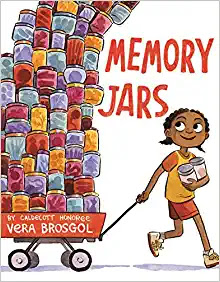
If Only! Memory Jars by Vera Brosgol
 <
<
ON A HOT, SWEET JULY DAY, FREDA WENT BLACKBERRY PICKING WITH GRAN.
THE BERRIES TASTED LIKE SUNSHINE.
THEY WOULD NEVER BE BETTER!
Still, Freda couldn't eat all those blueberries at once.
But Gran says she can save them for another time. They can put them in jars to preserve ALL the sweet goodness. Freda remembers Granpa eating blueberry jam on his toast when she was little..., and . . .
FREDA HAD AN IDEA!
She tries putting one of Gran's fresh chocolate cookies, hot out of the oven, in a jar, and when she opens the jar the next morning, the aroma of the cookie was sweet and fresh. Soon Freda sets out to save every good thing she loves--from beautiful music, a rainbow, and some stars she gathered from the night sky. When her best friend Jack was sad that he was moving to Arizona, she saves him in a jar. Finally, all of Freda's favorite things are saved in one jar or another! And Gran is almost out of empty jars. But one day, when they have eaten the last of the blueberry jam, Freda realizes that she has a problem!
Should Freda put the last hot toast with blueberry jam away in the jar? But then, she would never taste that warm crunchy toast with warm, sweet blueberry savor....
Maybe she should just live in the moment, in Caldecott honor-winning author-illustrator Vera Brosgol's latest, Memory Jars (Roaring Brook, 2021). There are problems, any way you go. Now, or later, which is best? And how many jars are there for all the things we love? Not enough! Vera Brosgol's endearing little preservationist is so charmingly cute that kids will delight in her little dilemma, which inspires us all to enjoy the moment, but also to see that sometimes it's best to just savor the memory.
Vera Brosgol's winning Caldecott Honor book is This One Summer.
Labels: Collectors and Collections--Fiction, Food (Grades Preschool--3
Preservation--Fiction, Grandmothers--Fiction, Jam--Fiction
Undercover Brother and Snoop Dog: Secret, Secret Agent Guy by Kira Bigwood
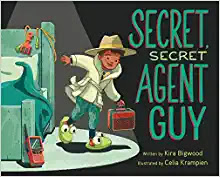
SECRET, SECRET AGENT GUY,
WORKING FOR THE FBI.
His trenchcoat and Fedora hanging on the door, the super sleuth relaxes in his PJ's and with his bullfrog-slippered feet on his desk, perusing the newspaper.
But a message comes through on his walkie-talkie from the intrepid chief, ordering him to grab his gear and get on the job. He stows his stuff in his kit, cleverly disguised as a third grade lunchbox--with ropes, grappling hook, and see-in-the-dark glasses. He slips downstairs on silent feet to surveil the security guards. Ah, there they are, busy listening to tunes on Alexa!
But his device begins to quiver with a message from headquarters. Chief directs him to a backpack stashed in the kitchen cupboard:
"SET YOUR TRAPS AND GET TO WORK!"
"IN THE SHADOWS SOMETHING LURKS!"
Suddenly the security guards send Spy Dog, who leaps over the deadfall trap set for them. Luckily, he's turned double agent, actually on their side! Grabbing the backpack in his mouth and trotting upstairs, he passes it over, and the secret agent guys attain possession of the contraband, a giant top secret lollipop concealed in the closet. But, OH, NO! The fake box broadcasts a call to the authorities!
MAY DAY! MAY DAY!
Could it be that their code has been blown? By a double agent sister...?
SECRET, SECRET AGENT GIRL!
It's "Curses, foiled again!" by a super-secret big sister, in Kira Bigwood's new Secret, Secret Agent Guy, (Atheneum, 2921), which we hope is the beginning of a brothers-and-sister secret agent wars series. It's a fun and funny kid pleaser, coded in spy lingo and a clever rhyme scheme, only slightly concealed, to be read and sung to the tune of "Twinkle, Twinkle, Little Star!"
"For readers looking for a little action and suspense in their bedtime story...." says Horn Book's reviewer.
Labels: (Grades Preschool--3, Bedtime--Fiction, Spies--Fiction, Stories in Rhyme
"I Am the Greatest!" The Ultimate Shark Rumble: (Who Would Win?) by Jerry Pollatta

When big sharks duke it out, who is greatest? In the waters of the world, the stakes are high when the biggest and the baddest boys in the shark world enter the ring to find out who the champion carnivore in the sea can be. Each one claims to be "The Greatest!"
When Saw Shark tries to cut a slice of Mako Shark, Mako makes short work of the duel, biting off the sawfish's tail! Mako wins! Hammerhead Shark is sure he's got all the right stuff. He can keep watch for opponents on both sides, as well as back and front. Bye-bye, Six-gilled Shark! You're too ugly to live!
And the great white shark only needs one knockout punch, er, one Great White bite, to take down the competition. But here comes the bulkiest big boy in all of sharkdom, the whale shark! However, he is lacking the one thing sharks are famous for--big teeth. Tiny teeth are good only for copping krill.
Whale shark goes down to the quick chomps of Black-tip Shark. So long, sucker! The same goes for the stocky little Leopard Shark when he confronts the thresher shark, whose long tail whips him right out of the competition.
Megamouth Shark looks tough with a mouth big as a barn door, but his teeny-tiny teeth can't take down Greenland Shark, who can live for 500 years, sharpening his fighting skills.
WHO WILL MAKE THE SHARK FINAL FOUR?
Mako Shark makes use of his lightning jab, biting off chunks of Bull Shark here and there. But Tiger Shark deftly takes both down for the count. But nearing the final round of the World Championship Match, Great White Shark tries a quick undercut punch, striking from below at Greenland Shark.
Now it's down to the top contenders--Great White Shark comes in to deliver a low blow from below, and Tiger Shark twists and attacks in the clinch with a quick big bite. First blood! The match is over! Tiger Shark Takes THE TITLE!
TIGER SHARK WINS!
Tiger Shark may be the greatest--this time, but there's always time for a rematch out there under the waves, in Jerry Pollatta's Who Would Win books offer many animal champs a rematch with their greatest contenders, in his Ultimate Shark Rumble (Who Would Win?) (24) Ultimate Jungle Rumble (Who Would Win?) (19) and Ultimate Dinosaur Rumble (Who Would Win?) (22)/a>
This is a vividly illustrated book, with Rob Bolston's action drawings, carried out in bright colors that capture the serious competition between all contenders. For kids who like some excitement along with their curriculum-co-ordinated animal behavior lessons, this book and the others in this series offer some exciting encounters for rising middle grade readers.
Labels: 1799-1883 (Grades 1-4), Sharks--Habits and Behavior
Meet the Neighbors! Five Busy Beavers by Stella Grosso
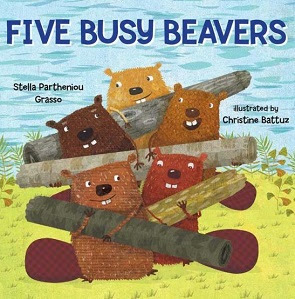
Building a beaver dam calls for all hands on deck.
But when one beaver sneaks away with a muskrat to play, his hard-working brothers, the remaining four, now have to do more!
But as the remaining four brothers "beaver on," chewing down trees to construct their lodge and dam, a lazy heron shows up to persuade one more of the brothers to run away to play!
That loss leaves the three all bereft, each one feeling sorry for himself. And soon some frolicsome frogs lead one more beaver in the bog to abandon his log. More playmates turn up, to lead the remaining brothers to be done for the day. as three frolicsome frogs and and a
tempting turtle lead two more away to play!
Only one beaver is left to do the job of building their dam made of logs.
Depressed, the last beaver brother finally paddles off by the dim light of a firefly. The dam's not done, and he is alone.
But as he swims to shore in a lonely, sad slog, he sees something new going up in the bog!
It seems the muskrat, the heron, the turtle and a trio of frogs, by the light of the firefly, have pitched in to finish the lodge with elan!>
"Many hands make light work," says the old saw, and in the bog that proverb comes true, as the five busy beavers celebrate with water lily pie and new friends with whom to watch the winter go by, in Stella Grasso's rhyming adaptation of the story of The Ant and the Grasshopper, Five Busy Beavers (Scholastic/Skyhorse, 2018). Grosso also adds her "Author's Notes, with more about the beavers' new neighbors who share the area around their dam.
With a bit of nature lore, counting lessons, and jolly verse in a novel rhyme scheme in store, Grosso's jolly picture book, illustrated with elan by illustrator Christine Battuz, is a fine seasonal read-aloud for preschool and primary kids.
Opines School Library Journal, "This original take on a classic is recommended as a general purchase for a primary collection. Great for a number-themed storytime or a lap read!"
Labels: (Grades K-4), Beavers--Habits and Behavior, Stories in Rhyme, Wetland Animals
Good Intentions Go a Long WAY! Tiny T. Rex and the Impossible Hug by Jonathan Stutzman
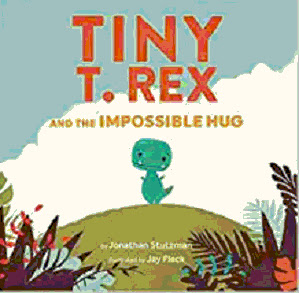
Little T. Rex is feeling blue, and not just because his skin is naturally baby blue. He's blue because his friend Pointy is very sad and needs a hug, and Tiny T. Rex's arms are way too short to deliver a big hug.
POINTY NEEDS ME!
Tiny T. Rex asks his family for help. But his dad, as mathematicians often do, turns his question into a mathematical equation!
POINTY DOESN'T LIKE MATH.
Mother counsels that it's not how long his arms are, but what's in his heart.
AUNTIE SUGGESTS CUCUMBER JUICE.
Tiny T. Rex's brother and sister say he needs to practice more.
.
"I WILL PLAN MY STRATEGY," TINY T. SAID. "I WILL PRACTICE MY HUGS."
Tiny T. Rex looked around for something to practice hugging. Perhaps a tree would work. He spots something tall and green with big arms.
It is a...
CACTUS!
Not a smart strategy, considering that the spines are quite sharp!
Tiny T. decides he need some altitude to spot a more suitable tree for hugging, so he hops on a flying dinosaur, but soon slides off, sailing down, down, down, until...
CONK! He lands right on top of Pointy's head and holds on tight.
"THAT WAS THE BIGGEST HUG EVER!"" SAYS POINTY.
It seems Mother was right. It's not the size of the hugger, but the size of his heart, in Jonathan Stutzman's Tiny T. Rex and the Impossible Hug (Chronicle Books).
As illustrated sweetly by artist Jay Fleck, Tiny T., this diminutive dinosaur certainly has plenty of heart, in author Jonathan Stutzman's book in his popular Tiny T. Rex series, starring as its undeniably charming and cuddly little hero. Other books in this series are Tiny T. Rex and the Perfect Valentine, Tiny T. Rex and the Very Dark Dark: (Read-Aloud Family Books, Dinosaurs Kids Book About Fear of Darkness), and Tiny T. Rex and the Tricks of Treating.
Labels: (Grades Preschool-2), Dinosaurs--Fiction, Hugging--Fiction, Persistence--Fiction
Friendship, Blendship! Chester's Way by Kevin Henkes
CHESTER HAD HIS OWN WAY OF DOING THINGS.
Chester and his friend Wilson were very punctilious. Chester always cut his sandwiches in triangles. He always got out of bed on the same side. He never left the house without his first-aid kit and double-knotted shoestrings. Wilson and Chester always signalled their turns on their bikes. They both never slid head-first into the plate in baseball. And on Halloween their costumes always went together, like pepper and salt shakers or ham and eggs. They did everything with each other.
"SOMETIMES I CAN'T TELL THOSE TWO APART. . . LIKE TWO PEAS IN A POD!" SAID CHESTER'S MOTHER.
His father agreed.
And then a new girl moved into the neighborhood. She did everything in a very unique way!
"I AM LILLY! I AM THE QUEEN.
I LIKE EVERYTHING!
Lilly plastered herself with bandaids so everyone would think she was very brave. She always carried a loaded squirt pistol when she left home. She talked backwards!
SHE NEVER LEFT HER HOUSE WITHOUT WEARING ONE OF HER DISGUISES.
Chester and Wilson hid when they saw Lilly coming, and when she phoned one or the other, they disguised their voices so they wouldn't have to play with her. She was just too weird for Chester and Wilson's taste.
But one day a couple of older bullies stopped them on the bike path, yelling and making fun of their precise hand signals and riding circles around them so that they couldn't move. Wilson and Chester were frightened! It was a scary situation, until...
A FIERCE-LOOKING CAT WITH HORRIBLE FANGS JUMPED OUT OF THE BUSHES....
The big boys pedaled away fast. Now who was frightened?
"ARE YOU WHO I THINK YOU ARE?" CHESTER ASKED.
Of course the fierce-looking cat with the water pistol is Lilly, and Chester and Wilson soon discover that her weird ways could sometimes be a good thing, in Kevin Henkes' classic story about friendship, in Chester's Way(Greenwillow Books).
It's different strokes for different folks, as Lilly introduces them to cookie-cutter shaped sandwiches and popping wheelies, and the boys teach Lilly the proper hand signals on her bike and how to double-knot her shoelaces. And Chester and Wilson learn to talk backwards so the three of them have their own secret language!
Of these brand-new different-drummer friends, Horn Book says, "The virtues of variety, experimentation, and friendship are deftly handled in the amusing, believable story."
Read more about Lilly, in Keven Henkes' best-selling Lilly's Purple Plastic Purse.
See the Sea Monster Here! Kraken Me Up by Jeffery Ebbeler
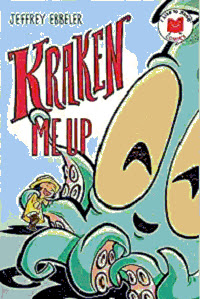
"BRING IN YOUR PETS!" ENTONES THE MASTER OF CEREMONIES.
Kids with all kind of critters have come together for the competition. There's a pretty pig, a hen nesting in her owner's hair, a lovable llama, and a . . .
KRAKEN!
(GULP!)
Never mind that he is BIG! One kid recognizes what he IS. A Kraken is a sea monster from the deepest deeps of the oceans of the world!
"A KRAKEN CAN EAT A SHIP!" YELLS THE KID WITH THE LLAMA.
His owner defends her pet:
"HE'S NOT MEAN! HE IS SHY."
The girl tells how she met him beside the sea and how they became friends.
But the other exhibitors in the Pet Show are not convinced. Izzie the Kraken is not allowed to compete. He's banished to the nearest body of water, a farm pond, into which he barely fits!
"FIND A WAY TO MAKE THEM SMILE," THE GIRL WHISPERS INTO HIS, ER, EAR, (OR WHATEVER THAT IS!)
BLAH-ZOOP! Kraken rares back and sprays his purple ink all over the kids, their parents, and the M.C.! For a moment they all are too astonished and amazed to move, so Kraken demonstrates the possibilities of face-painting with octopus ink on his own face. Suddenly, the kids see the potential of their situation.
Soon everyone is finger-painting each other with purple ink and giggling. But then the sea monster begins to cough.
HACK! HACK!
"THAT KRAKEN IS HACKIN,'" SAYS ONE PURPLE-PAINTED KID.
And Kracken hacks up a sailing ship, complete with cannons, cutlasses, captain, swabies, and all! The kid with the llama has to take credit for his prediction.
"I TOLD YOU THEY EAT SHIPS!" HE BRAGS.
And the crusty old ship's captain climbs out of the ship's quarters at last.
"YAR!
"WE BE IN THAT BELLY FOR FIFTY YEARS!!"style="color: #cc0000; font-family: Oswald;
"IT'S ABOUT TIME WE HAD SOME FUN."
Kraken has cracked up the whole crew, and it's the most memorable day ever at the Pet Show, in comic author-illustrator Jeffery Ebbeler's latest graphic comic book, Kraken Me Up (I Like to Read Comics) (Holiday House, 2021). Jeffery Ebbeler's graphic storybook puts all his comic artwork experience to bear on this one with as jolly a tall ship tall tale as a kid can imagine.
Says School Library Journal, "Girl and kraken are winners in any collection, especially where graphic novels for emerging readers are needed."
Labels: Graphic Novels, Krakens--Fiction, Pets--Fiction
(Grades Preschool--3)
Best Buddies: Dogs Love Cars by Leda Schubert
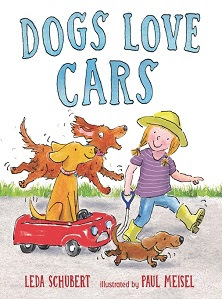
WINDOWS DOWN, NOSES OUT, EARS FLAPPING, DROOL ON THE WINDOWS....
Most dogs are mad about cars.
Don't get me wrong. Cats are great pets. But most cats are not fond of car rides. Having wind in their fur and faces does not particularly appeal to them. (They don't drool much, however.) But if you love a pet who likes to go places and do things outside in brand new places, dogs are ecstatic! (Most cats could not care less, (unless it's their idea!)
BUT DOGS LOVE CARS!
Dogs love to go for walks with their owner on the other end of the leash. They like to meet strange dogs and exchange sniffs. Dogs like pretty much everything about going places and doing things outdoors. Or indoors will do as if that's what you've got.
DOGS LOVE TOYS.
Floppy, bouncy, rolling, chewey, new, or old, dirty and disgusting, chewed up, broken, dogs adore 'em.
DOGS LOVE CHORES.
Dogs love washing cars, and they love digging dirt for any purpose known to man. (Cats, on the other hand, only dig for one purpose, one that most owners do not care to share!)
Dogs love to eat almost any kind of food, and some things that their owners don't even consider to be food.
But the best thing about dogs is that. . .
DOGS LOVE PEOPLE!
Dogs try to love cats, but that doesn't always work out so well! But in fact, the best thing about dogs is that they love their owners. And they usually want to love everything their owners love, even if that's a cat, in Leda Schubert's joyful, just published picture book in praise of all things canine, Dogs Love Cars (Candlewick Press, 2021).
With the funny child-centered illustrations of dogs being dogs, doing their thing, including loving their owners, by Paul Meisel, this is a book that almost anyone will love.
Says Booklist, "Energetic and appealing... a doggy delight!"
Labels: (Grades Preschool-3), Dogs--Fiction, Pets--Fiction
Dognabbit! Interrupting Cow: New Tricks for The Old Dog by Jane Yolen
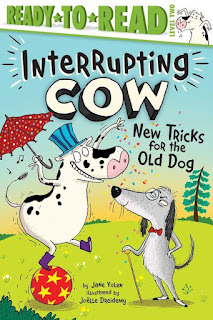
The cows were lounging around in front of the barn, when Interrupting Cow appears and tosses out an old cannard.
"KNOCK KNOCK!"
Interrupting Cow, giggled, rolling in laughter on the floor, while the clueless cows rack their brains for the meaning of that non sequitur, and an old gray dog appears in the barn door with a smug smile.
"NOT FUNNY!" REPLY THE COWS.
In a huff the cows vacate the barn. To the surprise of Interrupting Cow, the old dog giggles again, with a winner's chuckle.
For parents who've endured those "Guess What?/That's What?" jokes, look who's the one who gets the laughs now?
At least Old Dog gets a laugh out of Interrupting Cow this time in Jane Yolen's latest in her nonsense beginning readers, New Tricks for the Old Dog: Ready-to-Read Level 2 (Interrupting Cow) (Simon Spotlight, 2021). Make way for certain silliness here. It's Old Dog who scores the first giggle in this book by the noted Jane Yolen, author of the best-selling How Do Dinosaurs..., rhyming easy-to-read series.
Labels: (Grades Preschool-2), Chickens--Fiction, Dogs--Fiction, Jokes-Fiction
When Is A Hog Not A Hog? Hog Dog by Audrey Bea
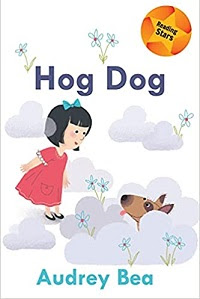
Through the mist of the morning a nattily-attired little girl, in blue hairbow and red dress, spies something ahead, partially obscured in the fog.
What could it be?
IT MAY BE A HOG.
Does its head look like a hog's? It does, sort of. Does its tail look like a hog's? What about those ears? Are they the ears of a hog... or a dog? Maybe.
I THINK IT'S A HOG DOG!
Author Audrey Bea makes good use of all twenty-nine words in this beginning reader book, as her charming little character collects the clues, in Hog Dog (Reading Stars)(Xist Publishing, 2021).
The focus is on what the author considers "sight words." Words like "a" and "I" certainly can be sounded out by anyone who knows the English alphabet, whereas their curious spellings make "through" and "tongue" are clearly sight words, easy to use as reading cues from the illustrations. The bright artwork by Franko Sviatoslav contrasts with the small clouds of fog make in appealing pages for young readers to puzzle over.
For another quickie reader for rookies in the Reading Stars series, see Audrey Bea's My Ball (Reading Stars).
Labels: (Grades Preschool-1), Beginning Readers, Dogs--Fiction, Hogs--Fiction
No Matter What the Weather: More Than Sunny! by Shelley Johannes
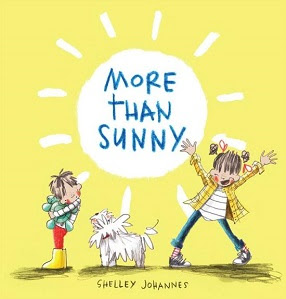
"IT'S EARLY!" GRUMBLES LITTLE BROTHER."
"IT'S SUNNY AND BIRDY" COAXES BIG SISTER."
She hustles her sibling into a spring jacket and outside beside the pond, where he complains...
"MUCKY!"
"IT'S SUNNY AND DUCKY!"...
. . . Sister counters, as a proud Mama Duck and a long line of little ducklings strut by.
And spring blows through as if on one long breezy day, until suddenly one warm sunny day, the siblings realize it's summer. Little Brother whines!
"IT'S MUGGY!" AND BUGGY!"
But as Shakespeare says, "Summer's lease hath all too short a stay."
As summer races by, the kids have fun, collecting caterpillars and worms and wishfully fishing and not catching fish, waiting out stormy, steamy, summer rain showers, suiting up in yellow slickers and boots, catching squirmy worms in the mud, and before they know it, summer melts away, to be replaced by whooshy winds and nervous, fussy, busy squirrels storing up acorns for the winter. And on one gray, cloudy day, they wave goodbye to the geese sailing by, heading south. And then it's. . .
"WINTER. AND WAITY!"
The two kids color and cut out Christmas decorations to hang from the windows with red yarn and watch at the windows for snowflakes to catch and melt on their tongues. And then it is snowy, and ready for sledding and chilling and spilling and then watching at their dark windows. . . .
And with a shushed sneaking downstairs to step out on the porch, they see... their very own falling star.
It's the grand finale of one more joyful trip around the sun to celebrate those blessed seasons of childhood, in Shelley Johannes' delightful latest, More Than Sunny (Abrams Books, 2021). It's all good weather to be together, and rain or shine, it's all fine!
Author Johannes' descriptive pairs of rhyming adjectives are as bouncy as the big sister's two ponytails, leading the way through the seasons, and artist Johannes' charming illustrations in pencil and mixed media are as lively and bright as the two young siblings in a sweet salute of the seasons, from spring glow to falling snow, late and lovely.
Says Publishers Weekly, "Breezy and buzzy/ summer and fuzzy!” transitions to “winter.../ and waity” before a sweet close focuses on a turnaround—and the night sky. Dynamic art rendered in pencil and mixed media on tracing paper and finished digitally matches the text’s energy in this charming seasonal perusal."
Labels: (Grades Preschool-3), Brothers and sisters--Fiction, Seasons--Fiction, Stories in Rhyme
There's A War On! Hetty and the London Blitz: A World War II Survival Story by Jeni Walsh
Hetty and her friend Judy were being fitted for a gas mask. Mrs. Wallace pulled on my mask's straps tighter and tighter.
"All set," she said. "Take a breath, Hetty." I did.
The rubber smell filled my nostrils. I fought for air through the filter. As the air came through, my skin was sucked into the mask like a vacuum. I didn't want to take another breath, but what choice did I have?"
Hettie felt fear when she heard her parents whispering together. With her family still grieving from the death of her baby sister, her parents seems to have a secret they were keeping from Hetty and her little brothers, Oliver and George.
But when Germany invaded Poland, her parents told her that Britain was at war with Nazi Germany, and now the mask had to go with her everywhere. When the air raid warnings sounded, her family had to cover all windows and sit together with all the lights out at night until the the sounds of warplanes overhead stopped and the sirens announced the German bombers were gone. At first the aircraft only flew over, headed for southern England, but soon the sound of exploding bombs grew closer and louder.
The family worked every day to build a dugout bomb shelter in their backyard. For Hetti, going down into that tomb-like hole at night was terrifying, but as houses in their neighborhood began to be hit by the enemy bombs, they had no choice. Some nights the Blitz came so close that they had to run for the crowded subway tunnels, the Underground, to escape the giant blockbuster bombs. Huge gas-filled barrage balloons bloomed over the school and city to prevent the enemy aircraft from being able to see their targets below. Even the cemetary nearby was hit by a blast, with rotting bodies and skeleton left scattered all around.
But then Hetty's greatest fear came true. The government had recommended that all children should be evacuated to the country to protect them far from the bombardment. Hetty and Oliver and little Georgie might have to leave their parents and go to live with strangers in the countryside.
And then a frightful thing happened.
A bomb hit the house next door. JUDY!
Mum was standing behind her, with George on her hip. She had tears in her eyes.
"It's time," she said. "It's time for you and your brothers to leave London."
Now, for Hetty, "Leaving London was my way of being brave."
And Hetty, just turned thirteen, and her little brothers go to live in the north with three strange couples, not to be with their own parents for over five years, five years of scarce, rationed food and loneliness for their home, Hetty separated from her brothers placed with two other families in a small farming town in the north of England, in Jeni Walsh's Hettie and the London Blitz: A World War II Survival Story (Girls Survive) (Capstone Books, 2021). Hetty was not to return to her parents and home for five years, but she dedicated herself to writing letters and helping her brothers remember their parents until word came that Hitler was dead and Germany had surrendered. It was V-E Day, Victory in Europe Day, and time to go home and begin to live in a new world for Hetty, George, and Oliver.
With simple but straightforward storytelling, Jeni Walsh gives middle readers, for whom World War II is long-ago, distant history, a sense and taste of the lives of the "removed" children" whose childhoods' were deeply changed during the war years, but saved to make the future in which today's children live.
Says School Library Journal, " Readers will be touched by Hettie's dedication to her family, her tenderness as an older sister, and her ability to keep happy memories alive from better times. Likewise, readers will be moved by the generosity of secondary characters in the English countryside like Hettie's foster mother who is initially cold, but warms up after sharing her own family story." With soft sepia illustrations by Jane Pica, there are also a glossary and author's notes appended.
Other historical fiction books in the Girls Survive series include Rebecca Rides for Freedom: An American Revolution Survival Story (Girls Survive), Charlotte Spies for Justice: A Civil War Survival Story (Girls Survive), and Molly and the Twin Towers: A 9/11 Survival Story (Girls Survive).
Labels: Great Britain--World War II--Fiction
Survival--Fiction
(Grades 4-7)